Introduction
Political context: continuity, succession and institutional renewal
On 4 October 2026, Brazilians will choose a president, governors, two senators, a federal deputy and a state or district deputy. The ballot renews every seat in the Chamber of Deputies and 54 of the Senate’s 81 seats. If no presidential ticket receives a majority of valid votes, a second round follows on 25 October. The election therefore renews both the executive and much of the institutional structure that will determine whether the eventual winner can govern. [S001] [S002] [S083]
Luiz Inácio Lula da Silva enters the campaign as the incumbent and one of the most enduring figures in Brazilian democracy. He governed from 2003 to 2010, returned to office in 2023 after winning the 2022 election, and is seeking a fourth non-consecutive term. The vote will therefore judge the current administration while also deciding whether to extend a political project that has shaped national politics for more than two decades. [S124]
Jair Bolsonaro, Lula’s opponent in 2022 and the central figure of the Brazilian right since 2018, cannot run. The Superior Electoral Court declared him ineligible for eight years from the 2022 election, and he is serving a 27-year prison sentence for the attempted overturn of that result, under house arrest at the cutoff on health grounds. His eldest son, Senator Flávio Bolsonaro, was the expected Liberal Party nominee and was seeking to inherit both his father’s electoral base and his unresolved coalition-building challenge. [S125] [S126] [S111]
The 2026 election is therefore neither a simple replay of 2022 nor a conventional open succession. It is simultaneously a referendum on Lula’s current administration, a test of whether the Bolsonaro movement can transfer its coalition from father to son, and a nationwide contest for control of Congress and the states. Because voters can split their tickets across parties, the presidential winner may still emerge without a coherent legislative mandate. For the Brazilian real, the combined governing arrangement matters more than the presidential name alone. [S001] [S002] [S083] [S111]
That distinction is particularly important now. Brazil enters the campaign with high interest rates, debt above 80% of GDP, inflation expectations above the central bank’s goal, a Congress with growing control over budget resources and an escalating trade dispute with the United States. The same presidential winner could lead a relatively stable government, a constrained but functional administration, a powerful expansionary government or a fragmented government unable to resolve fiscal and institutional conflicts. Each configuration carries a different set of risks for the real. [S013] [S014] [S024] [S030] [S098]
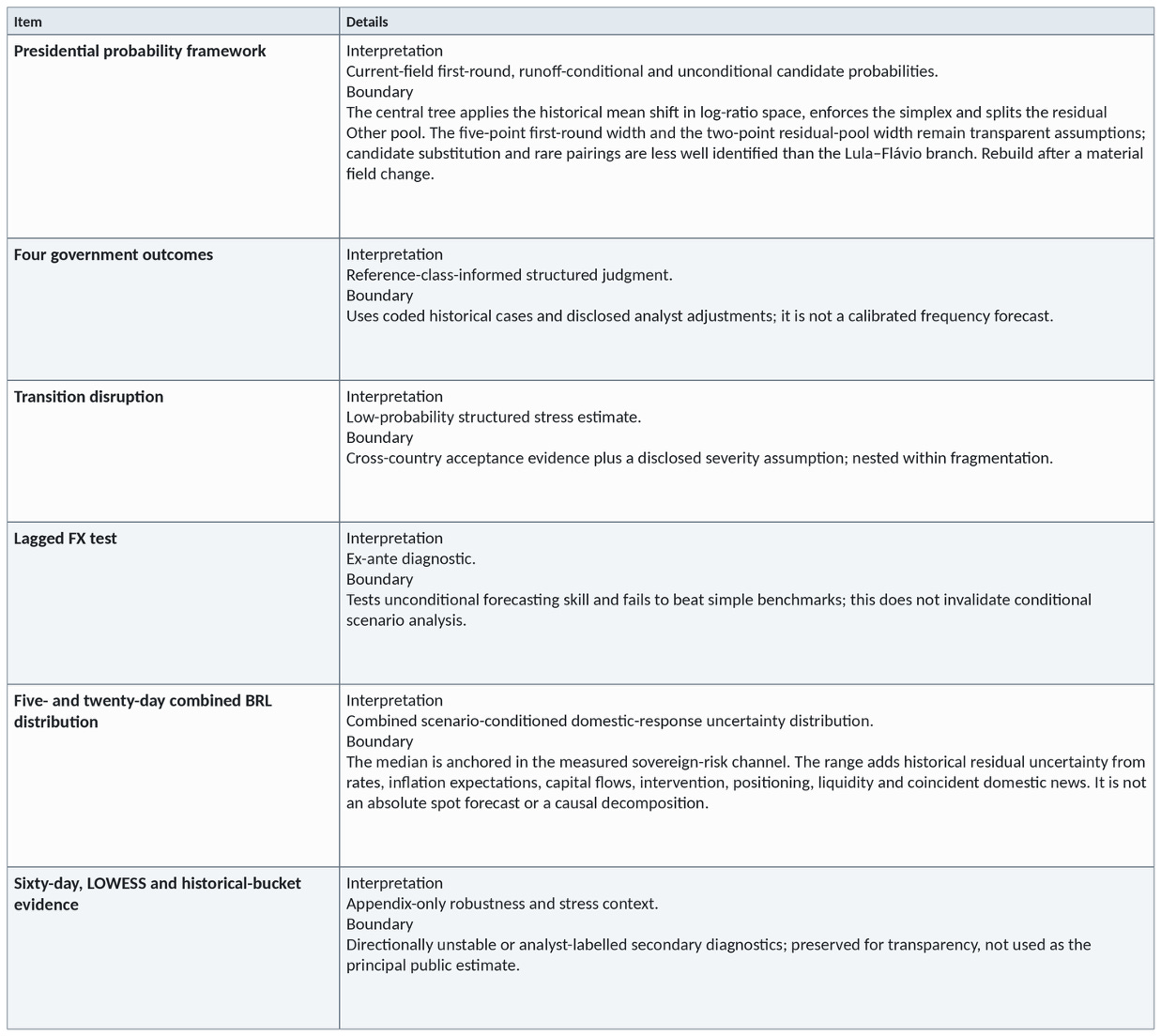
The report proceeds in three stages. First, it explains what Brazilians will vote for and how the country’s principal institutions share power. Second, it calculates a current-field first-round, runoff and unconditional presidential probability tree for the six named candidates, while retaining the Lula–Flávio matchup as the best-identified branch, and evaluates four possible post-election governments. Third, it estimates a combined scenario-conditioned distribution for the real after five and twenty trading days. The median is anchored in the measured sovereign-risk channel, while the uncertainty range adds the historical scale of other domestic channels that elections can affect—including expected rates, inflation compensation, capital flows, intervention, positioning and liquidity—together with coincident domestic news. The result is an estimate of incremental domestic political pressure under a common external baseline, not an absolute USD/BRL forecast.
Contents
· Introduction: why Brazil is electing more than a president
· Executive summary
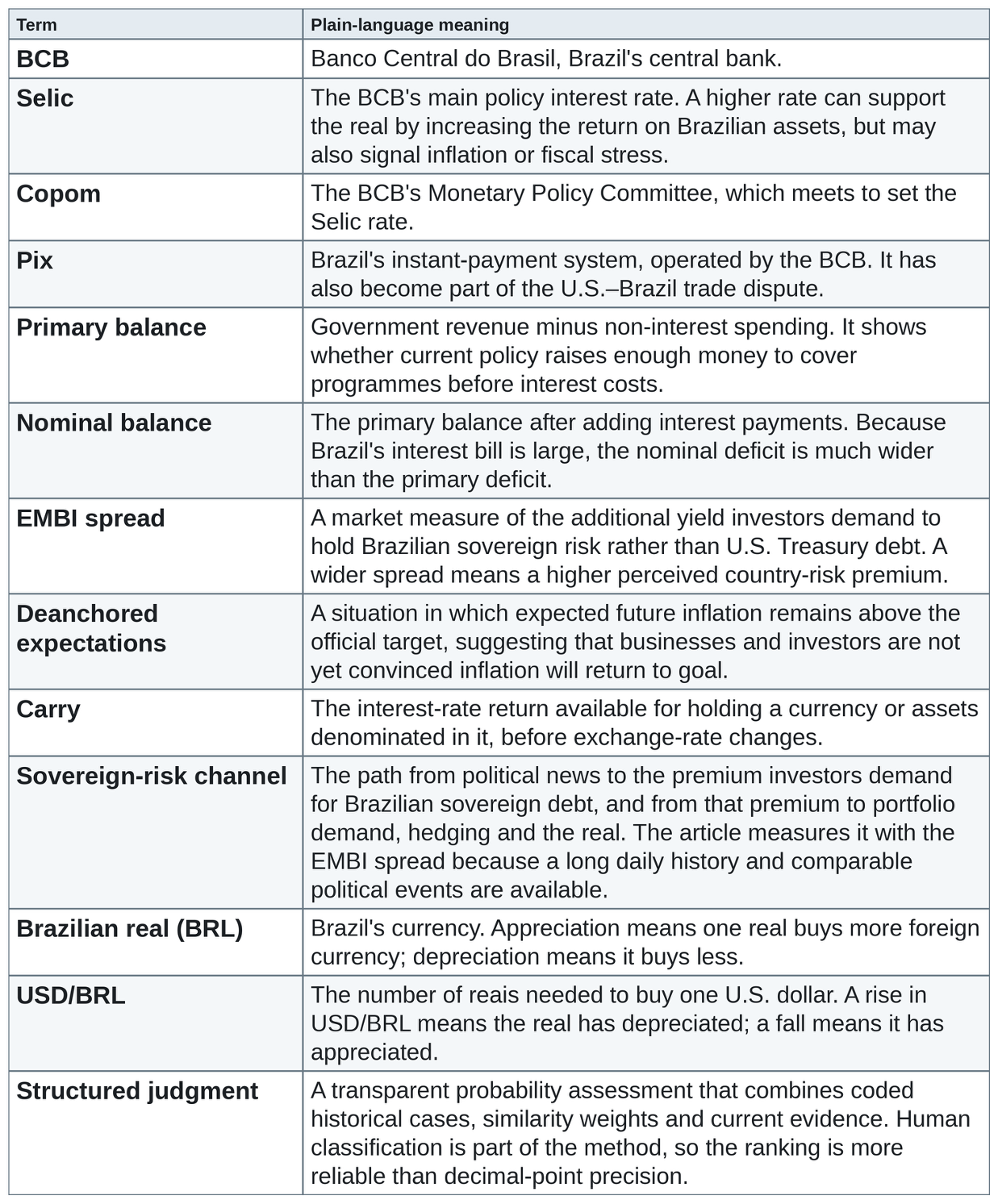
· A quick guide to the terms used in this report
· 1. Beyond the presidential candidate, multiple key figures to be elected
· 2. From votes to policy: many intermediary institutions
· 3. First-round, runoff and unconditional presidential probabilities
· 4. The economic starting point
· 5. What Brazil’s recent elections teach us
· 6. The political outcomes that can affect the real
· 7. Four possible governments
· 8. Combined scenario-conditioned pressure on the real
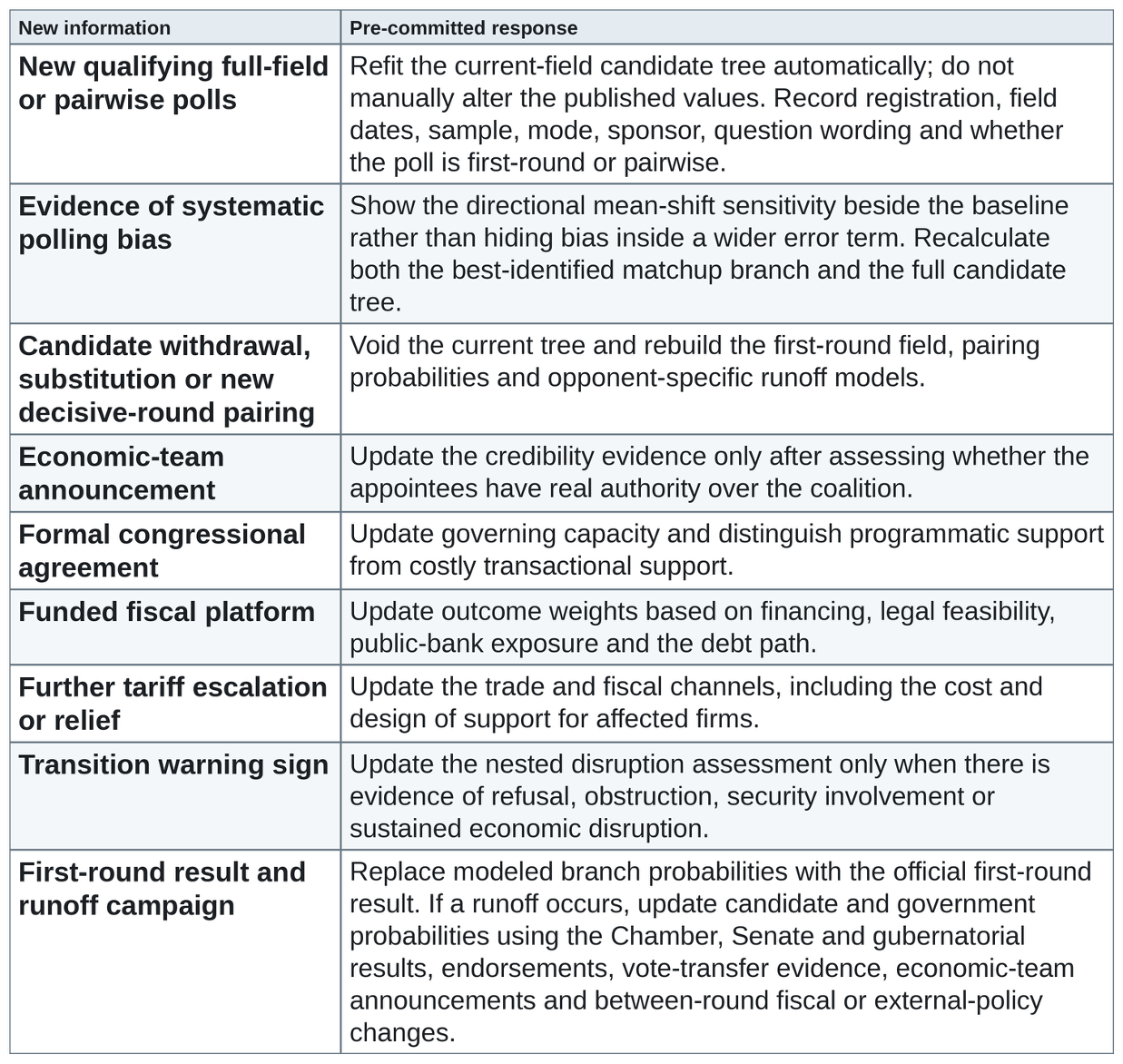
· 9. What would change the assessment
· Conclusion
· Appendix A. Quantitative methods and updating logic
· Appendix B. Sources and reproducibility
· Appendix C. Confidence, unresolved issues and methods without satisfactory solutions
Executive summary
A quick guide to the terms used in this report
1. Beyond the presidential candidate, multiple key figures to be elected
On 4 October, Brazilian voters make six choices in the same first-round election: federal deputy, state or district deputy, a first senator, a second senator, governor and president. All legislative seats are settled that day. Only the presidential and gubernatorial contests can proceed to a second round on 25 October if no candidate obtains the required majority of valid votes. [S001] [S002] [S083]
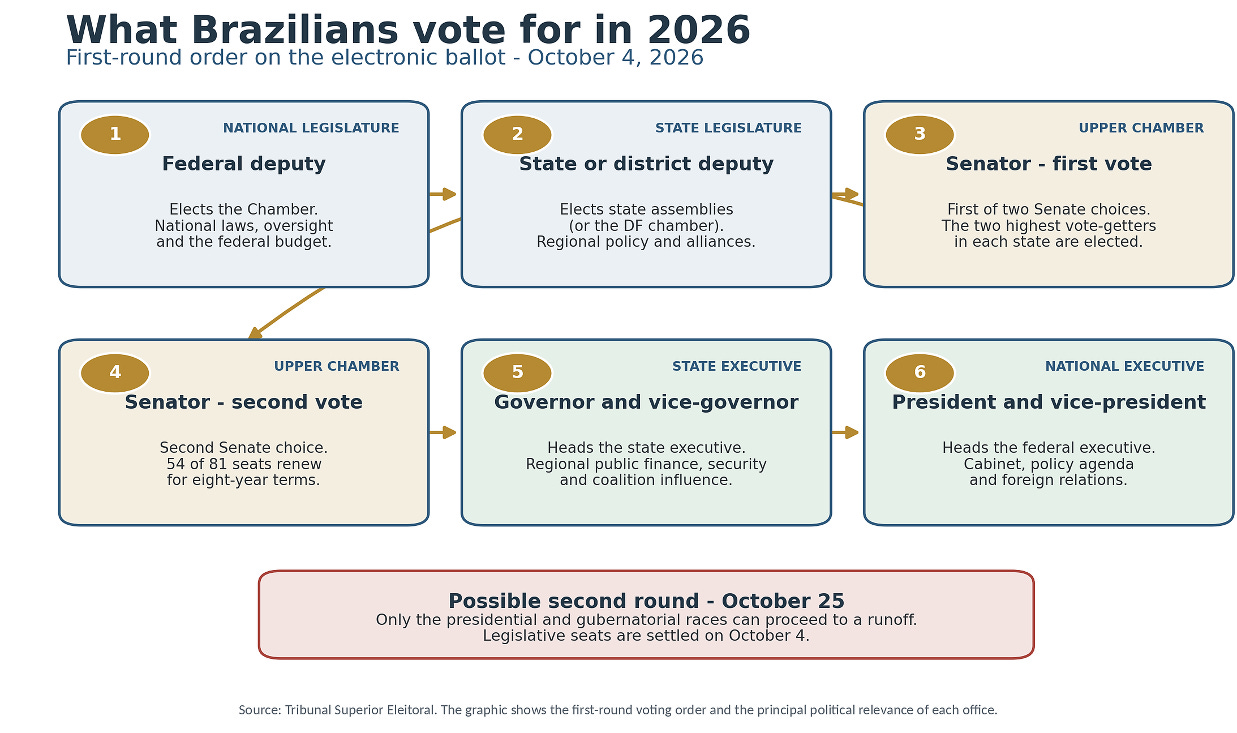
Figure 1. The six first-round choices on 4 October 2026 and the contests that can proceed to a second round.
This simultaneous ballot makes a single, unified mandate unlikely. A voter can support Lula for president, an opposition senator, a centrist federal deputy and a governor from another party. The price impact of the election therefore depends on the combined result: who wins the presidency, who controls each chamber, and how much political bargaining the winner must undertake.
The Senate result is especially important. Fifty-four of 81 seats are contested and the winners serve eight-year terms. The Senate confirms BCB directors and Supreme Federal Court justices and participates in constitutional amendments, debt rules and major legislation. Its composition can constrain the next president well beyond the four-year presidential term. [S002] [S084]
2. From votes to policy: many intermediary institutions
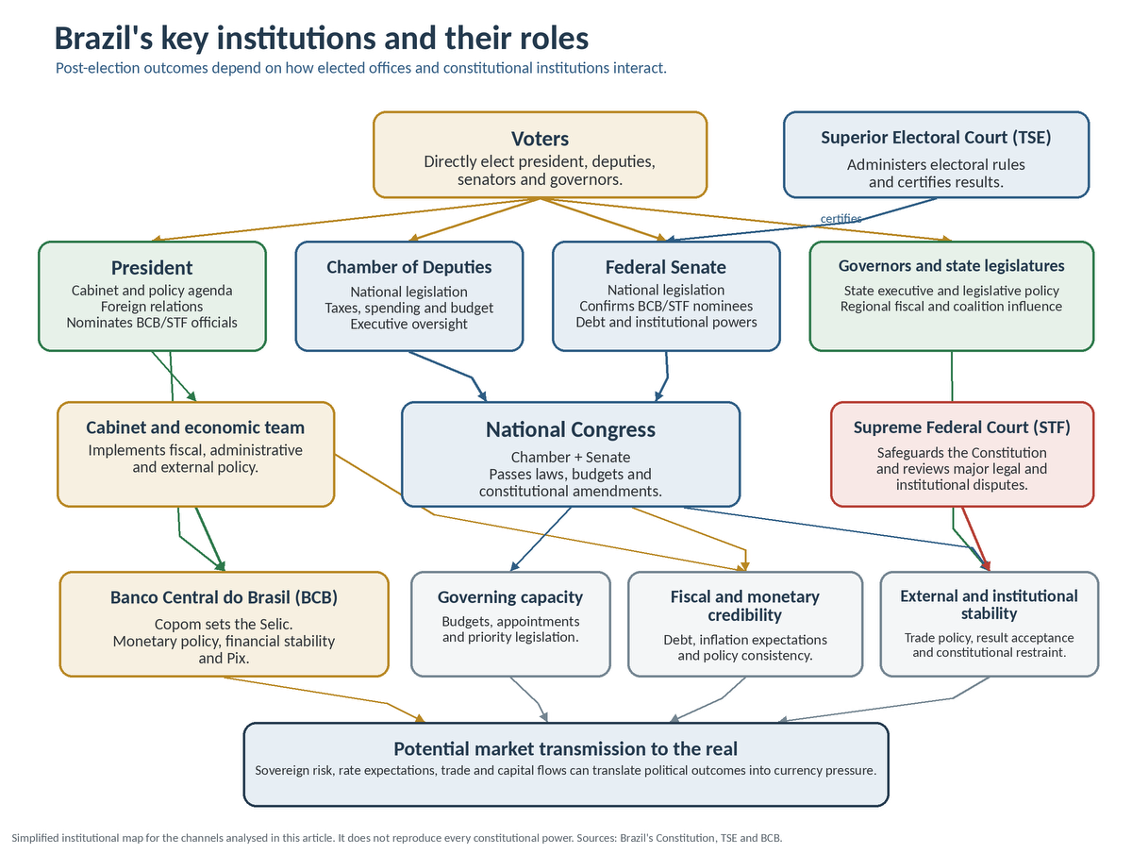
Figure 2. The principal institutions that shape the post-election government.
The president appoints ministers, proposes the federal budget, directs foreign policy and nominates senior officials. The Chamber of Deputies and Federal Senate together form the National Congress, which passes taxes, spending measures, ordinary laws and constitutional amendments. The Senate separately confirms key appointments. The Supreme Federal Court (STF) interprets the Constitution and resolves major institutional disputes. The Superior Electoral Court (TSE) administers the election and applies electoral rules. The BCB conducts monetary policy within a legal autonomy framework. [S084] [S085]
Governors also matter. They lead state governments, influence regional party organisations and can help or hinder the president’s attempts to assemble congressional support. A national presidential victory combined with weak performance in large states can produce less bargaining power than the presidential vote alone suggests.
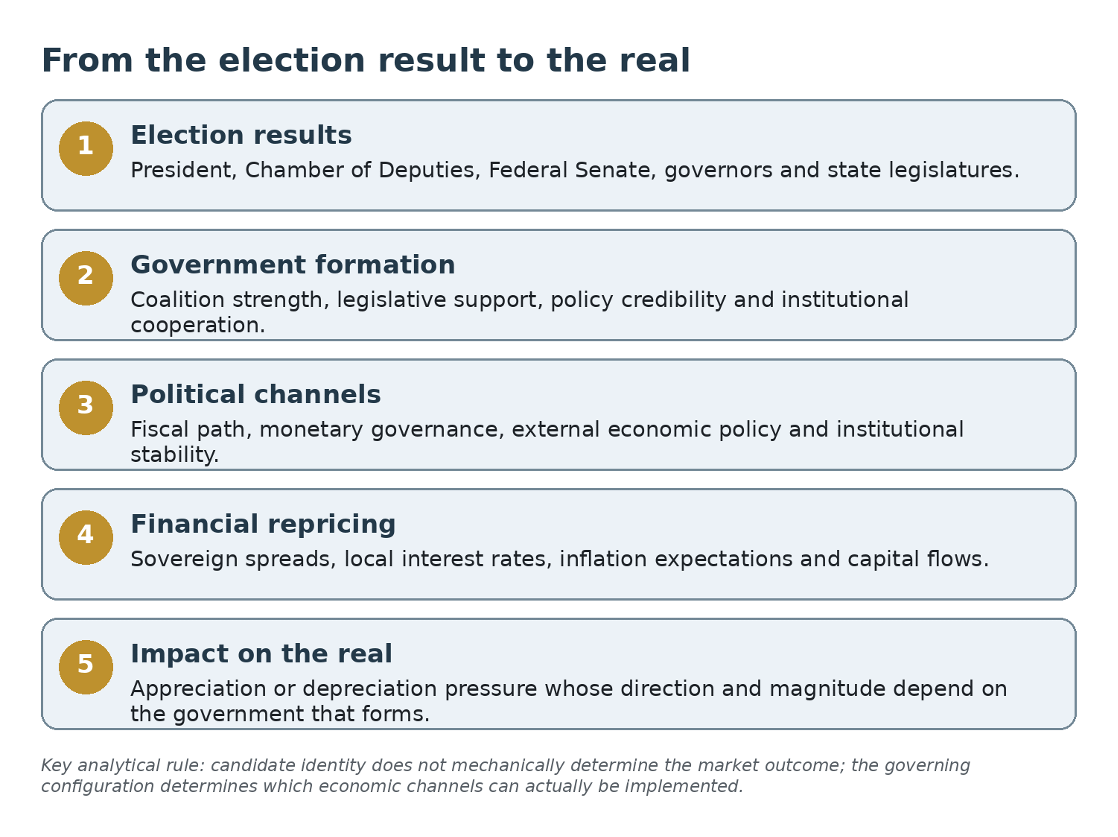
Figure 3. The article’s causal logic: votes affect the real through government formation and financial repricing.
3. First-round, runoff and unconditional presidential probabilities
The current-field probability tree uses the latest qualifying national full-field poll from each of 11 polling organisations. Each poll had to be publicly released and registered with the TSE, have national coverage, finish fieldwork within 45 days of the cutoff and be published by 25 July at 03:00 BRT. The model converts named candidates and the residual “other candidates” category to valid-vote shares, excluding blank, null and undecided responses. The historical directional mean is applied as an odds tilt inside log-ratio space before the softmax, so every draw remains non-negative and sums to one. [S127] [S128] The Lula–Flávio head-to-head branch uses a frozen 14-organisation runoff universe. [S003] [S005] [S006] [S091] [S092] [S093] [S094] [S095] [S096] [S097] [S099] [S100] [S108]
The modeled named field at the cutoff is Lula, Flávio Bolsonaro, Ronaldo Caiado, Renan Santos, Romeu Zema and Augusto Cury. The central model divides the residual 2.7% other-candidate pool among four anonymous candidates when selecting finalists and calibrates its aggregate final-share standard deviation to 2.0 percentage points, compared with 1.46 points of observed cross-poll dispersion. Higher-volatility, more concentrated and single-residual-candidate treatments are sensitivity cases.
The calculated current-field probability tree
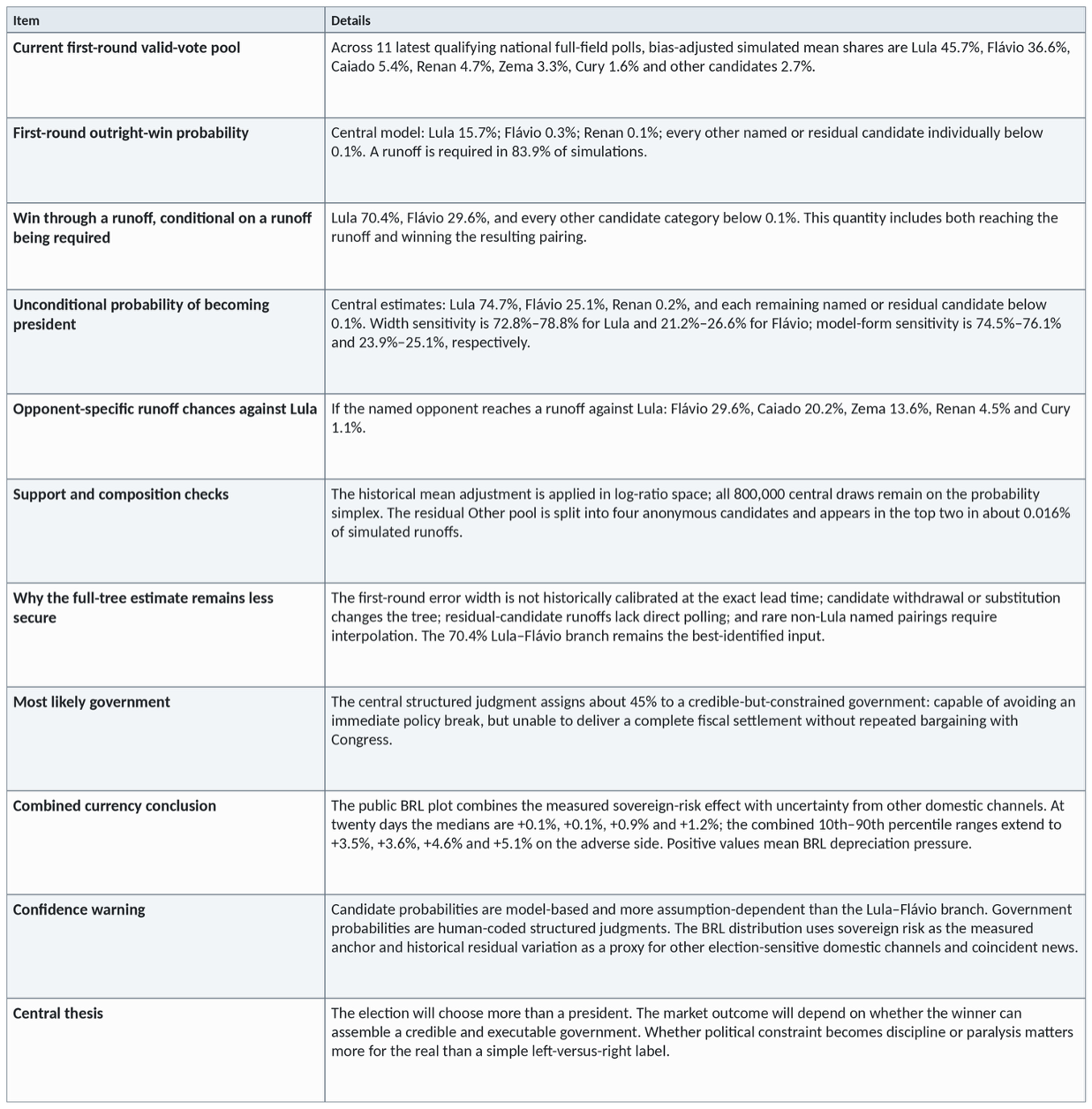
1. Probability of an outright first-round win. This is P(candidate c receives more than 50% of valid presidential votes on 4 October). Under the central model, Lula is at 15.7%, Flávio at 0.3%, Renan at about 0.1%, and every other named or residual candidate below 0.1%. A runoff is therefore required in 83.9% of simulations.
2. Probability of becoming president through the runoff, conditional on a runoff being required. This quantity includes both reaching the runoff and winning the resulting pairing. Under the central model, Lula is at 70.4%, Flávio at 29.6%, and every other named or residual candidate category below 0.1%. Because it is defined across all candidates and all simulated pairings, this column sums to 100%.
3. Unconditional probability of becoming president. This combines every route to office: an outright first-round win plus the runoff branch, weighted by the probability that a runoff is required. The central estimates are Lula 74.7%, Flávio 25.1%, Renan about 0.2%, and Caiado, Zema, Cury and the aggregate residual category below 0.1%. Across the 3.5–6.5-point first-round width sensitivity, Lula ranges from 72.8% to 78.8% and Flávio from 21.2% to 26.6%. At the five-point width, alternative logistic-normal, Dirichlet and residual-candidate specifications place Lula at 74.5%–76.1% and Flávio at 23.9%–25.1%.
The opponent-specific runoff probabilities answer a different question: conditional on that exact candidate facing Lula, the estimated chances of defeating him are Flávio 29.6%, Caiado 20.2%, Zema 13.6%, Renan 4.5% and Cury 1.1%. Those figures are not the candidates’ unconditional presidency probabilities because they do not include the probability of reaching that pairing.
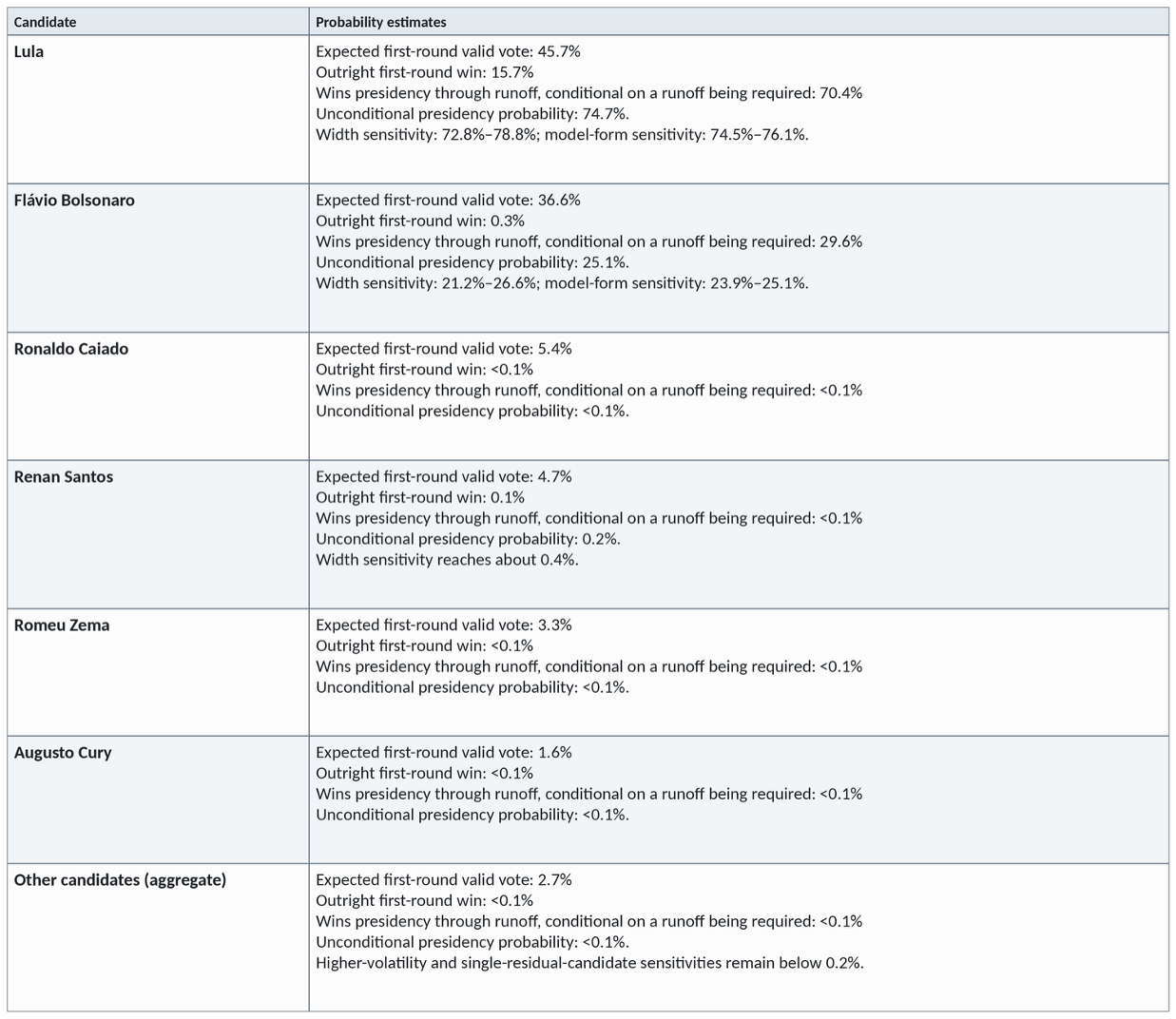
Support, composition and robustness
The historical mean shift is applied before the softmax, every simulated vector is checked against the probability simplex, the residual Other pool is divided among anonymous candidates, and calibration constants are derived numerically from the frozen poll panel. Across 800,000 central draws, there are zero support violations; an anonymous residual candidate appears in the top two in about 0.016% of runoffs. These checks reduce support and aggregation risk without eliminating uncertainty about first-round error width, field changes or rare pairings.
For any candidate c, P(c becomes president) = P(c wins in the first round) + P(a runoff is required) × P(c becomes president through the runoff | a runoff is required). In the central simulation, P(runoff required) is 83.9%, and a Lula–Flávio pairing represents 99.2% of simulated runoffs. The full runoff term nevertheless averages over every pairing; pairings that exclude c contribute zero to c’s probability. The first-round, runoff-conditional and unconditional columns therefore each have a distinct interpretation, and the unconditional probabilities sum to 100% across named and residual candidates.
If a runoff is required, the three-week campaign becomes a major update window. The Chamber, Senate and gubernatorial results will already be known; endorsements will reveal vote-transfer patterns and coalition breadth; and fiscal commitments or economic-team announcements can change both the candidate probabilities and the four government probabilities before the second vote. Every new qualifying poll can be incorporated under the frozen rules, while a candidate withdrawal or substitution invalidates the current tree and triggers a full rebuild. Section 9 specifies the broader update rules.
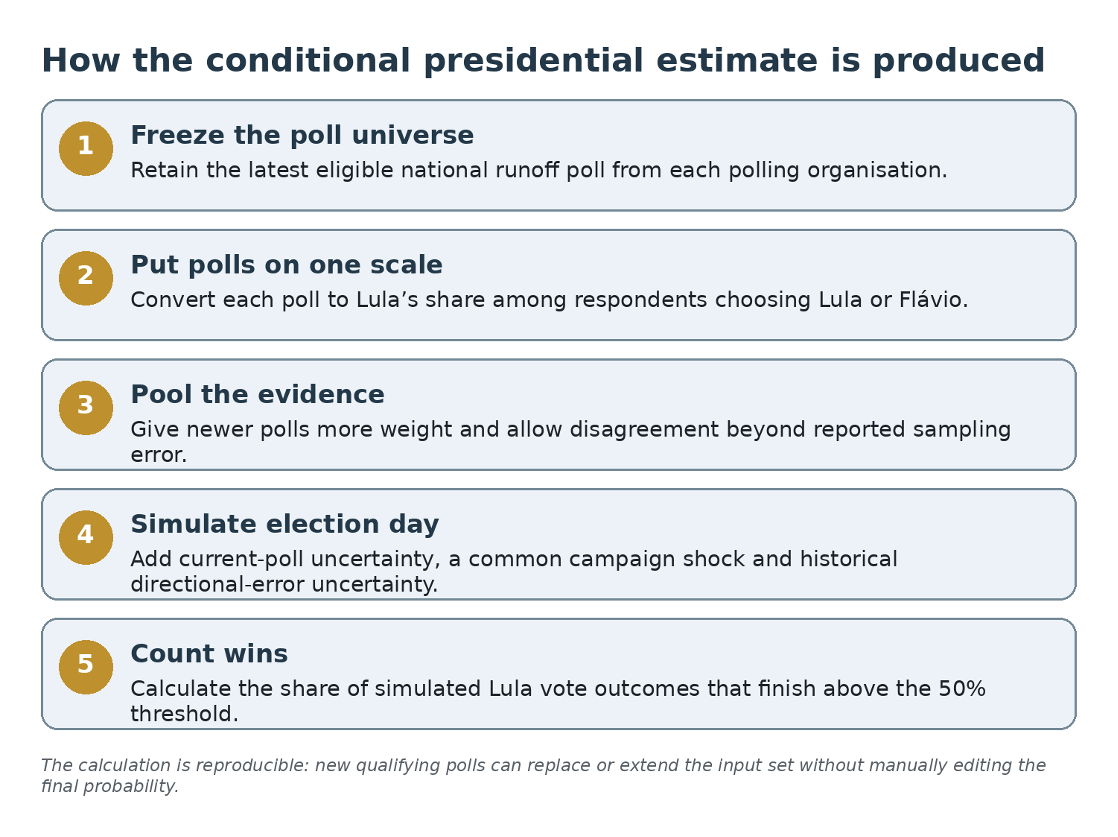
Figure 4. How the polling estimate is built, from published polls to simulated election outcomes.
The calculation has five steps. First, each poll is converted into Lula’s share among respondents choosing either Lula or Flávio. For example, a poll reporting 45% for Lula and 42% for Flávio implies a two-candidate share of 45/(45+42), or 51.7%, for Lula. Second, newer polls receive more weight, with weight declining by half every 30 days. Third, a random-effects calculation allows pollsters to disagree by more than their reported sampling margins. Fourth, the model simulates the remaining campaign and common polling error. Fifth, it records how often Lula’s final share remains above 50%. [S045] [S047]
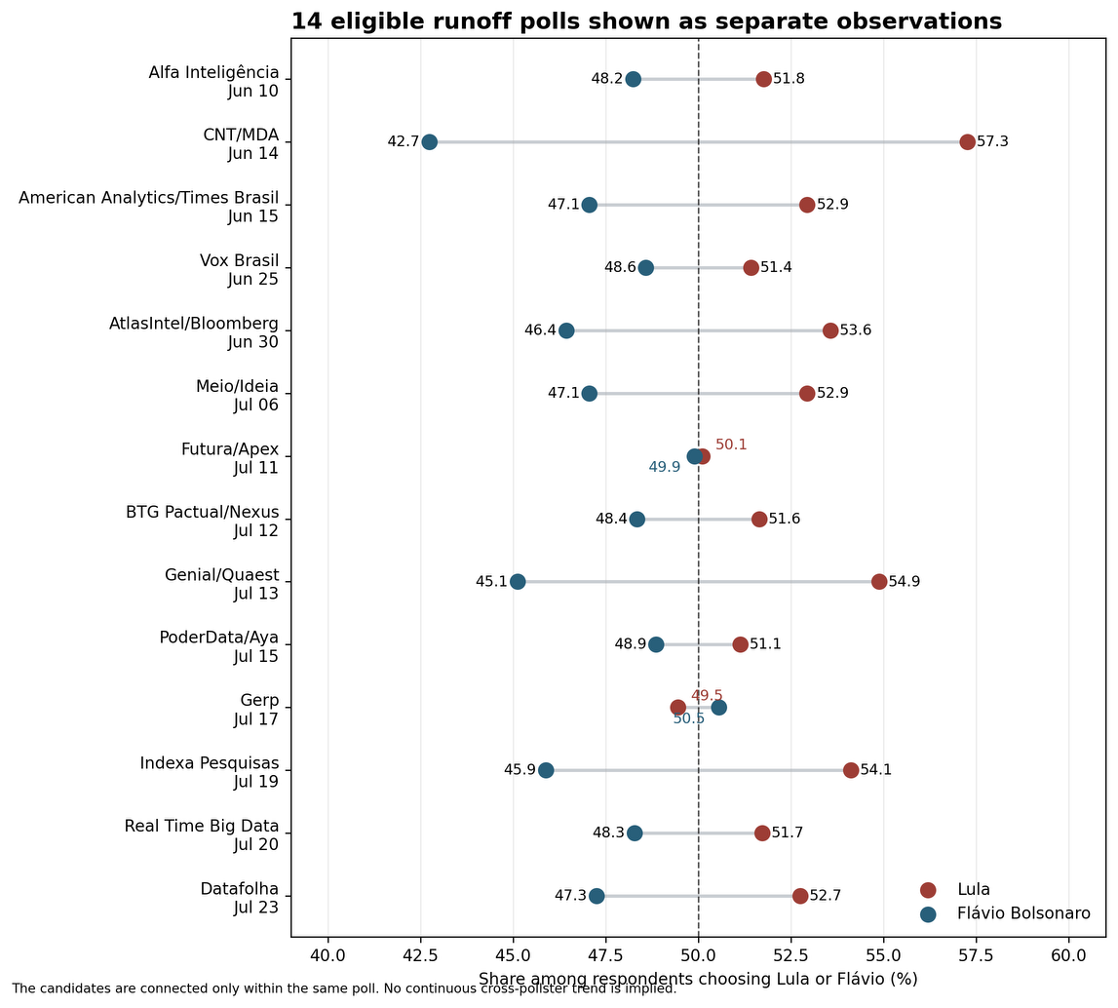
Figure 5. The 14 eligible runoff polls are shown as separate observations rather than connected into a false trend.
How the simulation represents uncertainty—and why the baseline is bell-shaped
The simulation combines three sources of uncertainty. The pooled poll estimate first receives an approximately normal sampling distribution on the log-odds scale, which keeps simulated vote shares between 0% and 100%. A common campaign-and-polling shock then captures shared turnout mistakes, undecided-voter movement, campaign events and other errors that could move several polls together. That shock follows a Student-t distribution with five degrees of freedom and is scaled to the chosen 3.5-, 5.0- or 6.5-point standard deviation. The baseline uses five percentage points of the final two-candidate vote.
The bell-shaped baseline is an assumption about relative plausibility, not a claim that campaign errors follow one uniquely correct mathematical law. Once the separate historical directional-bias component is handled, the available evidence gives no reliable reason to expect an error of a given size to be more likely in one direction than the other. It is also more plausible that the final result remains close to the current pooled estimate than that it moves by five or ten points. A symmetric, single-peaked distribution expresses those judgments: one centre, equal treatment of positive and negative deviations, and steadily lower probability as the absolute move becomes larger.
Other distribution families would require additional assumptions that the available data cannot support. Uniform or triangular distributions need arbitrary hard limits; skewed distributions need evidence of persistent one-sided errors; multimodal mixtures need identifiable alternative campaign regimes and estimable mixing weights; and a purely empirical distribution would be unstable with only five historical runoffs, especially because those observations were measured near election day rather than eleven weeks before it. Among symmetric, single-peaked choices, a normal curve would assign less probability to large shared surprises than is prudent when polling errors can be correlated and campaigns can move abruptly. The Student-t distribution with five degrees of freedom keeps most probability near the centre while allowing thicker tails. It is a parsimonious baseline rather than the only conceivable choice; the narrower and wider scale cases and the separate directional stress shifts test the consequences of changing its width or centre.
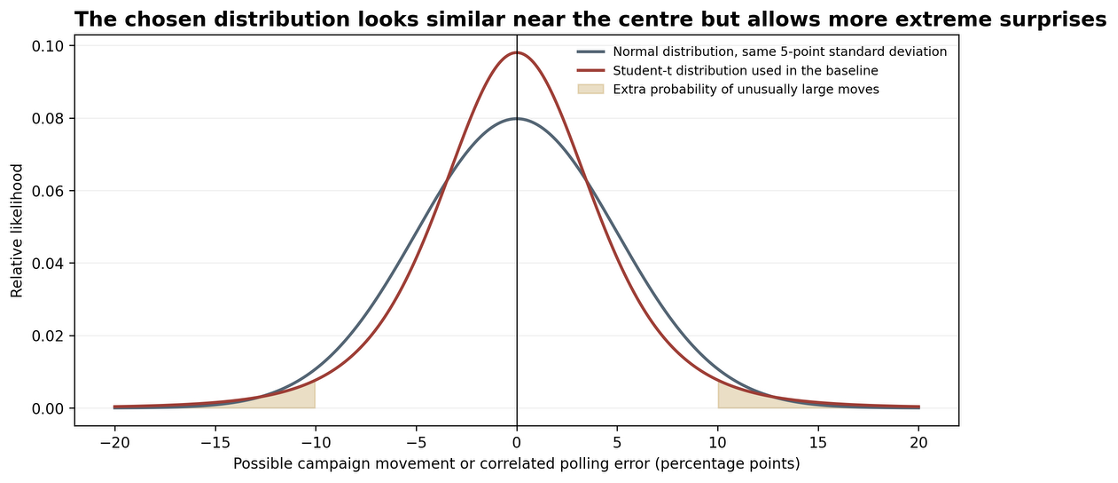
Figure 6. Among symmetric, single-peaked choices, the Student-t keeps most probability near the centre while allowing more extreme surprises than a normal curve.
The model also uses a historical directional-error calibration. A frozen final-seven-day rule identifies 27 polls across the 2006, 2010, 2014, 2018 and 2022 runoffs. Each election contributes one industry-level error, so a year with many pollsters cannot dominate the estimate. The average error is small and pro-left, but five elections provide little precision. A weak zero-centred prior and a heavy-tailed predictive distribution keep that uncertainty visible. [S113][S114] [S115] [S122] [S123]
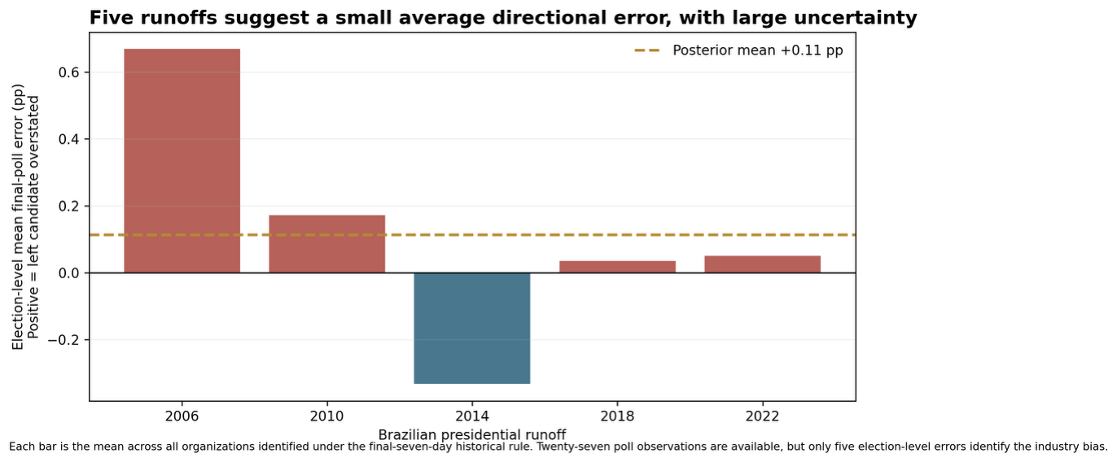
Figure 7. Historical final-poll error is small on average but identified by only five runoffs.
The historical component shifts the centre of the error distribution while leaving the declared total width unchanged. Positive historical error means final polls overstated the left candidate, so the corresponding draw is subtracted from Lula’s pooled share. The remaining campaign-drift variance is chosen so that total non-sampling uncertainty still equals 3.5, 5.0 or 6.5 percentage points. The five-point baseline remains an explicit assumption; the historical sample informs direction more than the full amount of movement eleven weeks before the vote.
Why 52.4% of a Lula–Flávio runoff vote can correspond to about 70% chance of winning that matchup
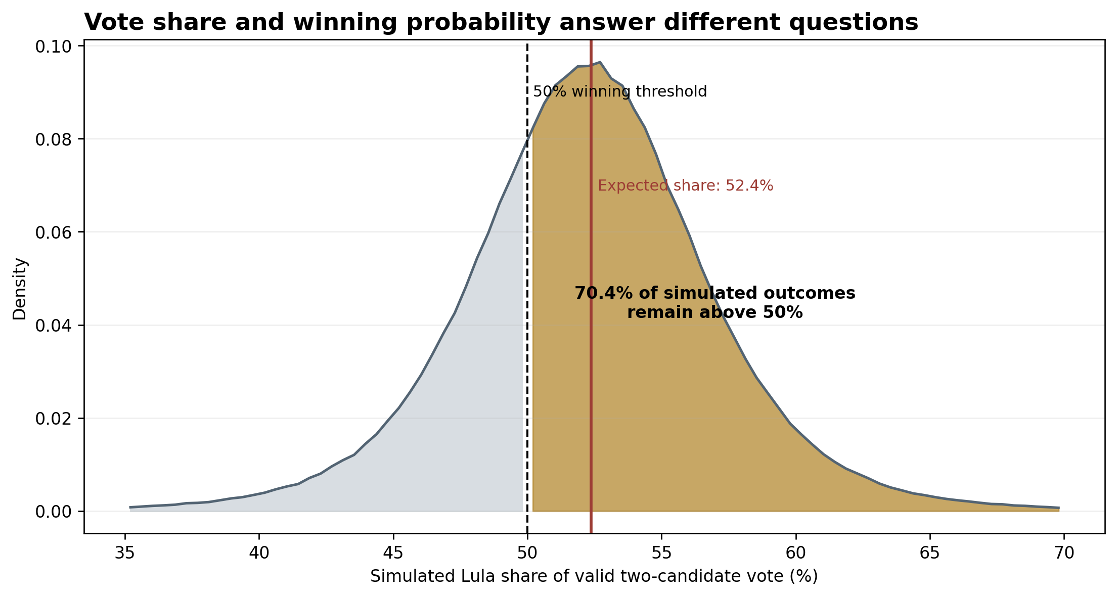
Figure 8. Expected Lula–Flávio vote share and the matchup-specific probability of finishing above 50% answer different questions.
The expected share is 52.4%—the centre of the simulated Lula–Flávio runoff distribution. The 70.4% probability is the proportion of that matchup distribution above the 50% threshold. In the current-field tree, this best-identified branch is combined with Lula’s 15.7% outright-win probability and the 83.9% runoff probability, producing a 74.7% unconditional Lula presidency estimate. The corresponding unconditional estimate for Flávio is 25.1%. Renan is about 0.2%, while the remaining named and residual candidates are each or collectively below 0.1% in the central case. [S060] [S127] [S128]
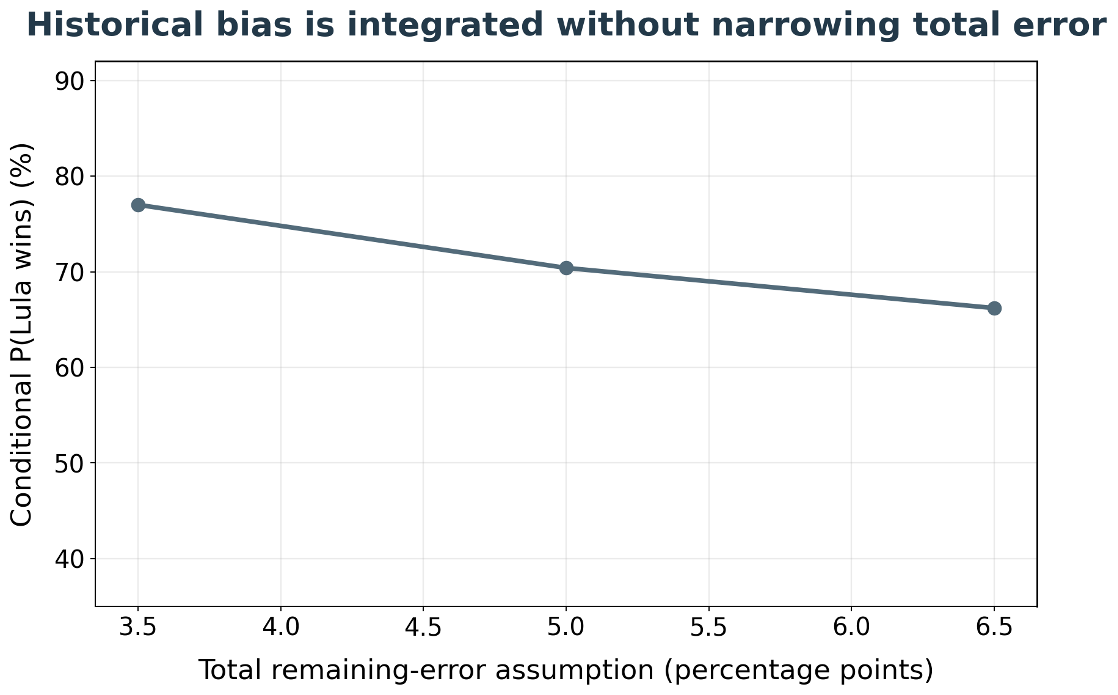
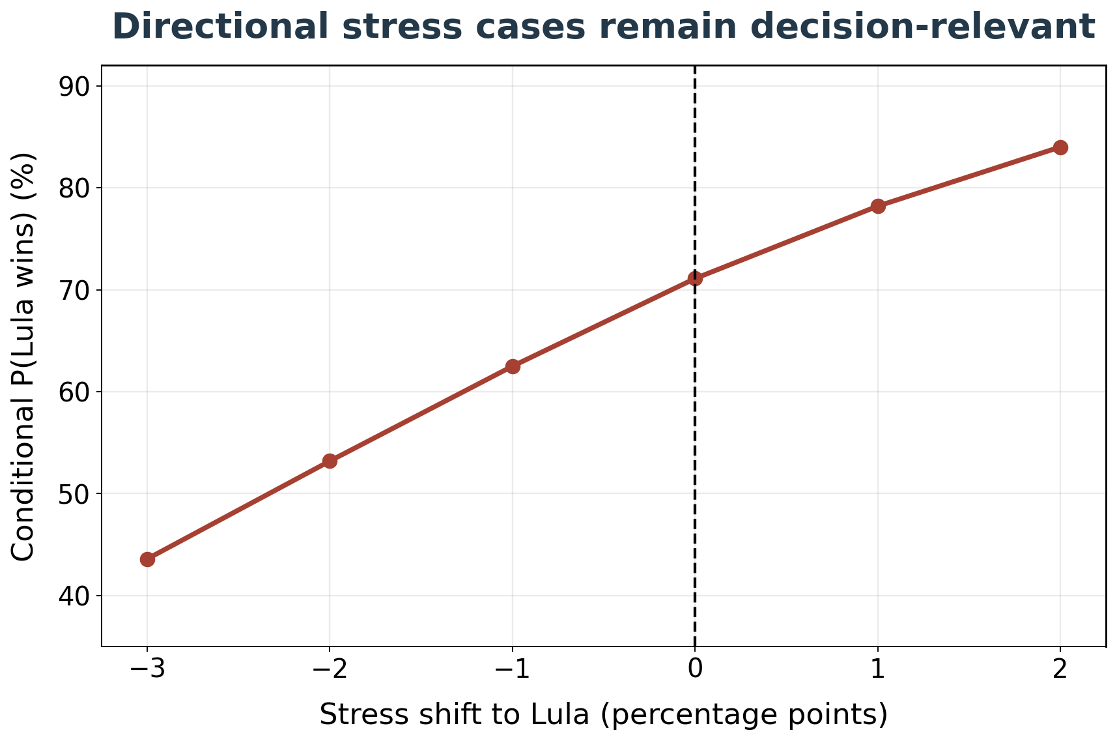
Figure 9. Historical directional error, total uncertainty and stress shifts all affect the conditional probability.
The number most likely to be misquoted
The headline 70.4% is P(Lula defeats Flávio | a Lula–Flávio runoff occurs) under a five-point standard deviation for total remaining non-sampling error. The full-tree unconditional estimate is 74.7% for Lula, while his outright first-round probability is 15.7%. Flávio’s unconditional estimate is 25.1%. A symmetric Lula–Flávio comparison centred at zero gives about 71%; a two-point systematic error against Lula reduces that matchup estimate to about 54%, and a three-point error reduces it to about 44%. These stress values apply to the Lula–Flávio branch and should not be substituted mechanically for the full-tree probabilities.
The candidate-probability script reproduces the first-round pool, algorithmic calibration, simplex checks, residual-candidate treatment, pairwise runoff estimates, 3.5-, 5.0- and 6.5-point width cases, and the logistic-normal, Dirichlet and residual-pool sensitivities from frozen inputs and fixed random seeds. The technical supplement documents the inputs, support diagnostics and sensitivity results.
4. The economic starting point
The next government will not begin with a blank balance sheet. The BCB’s June Monetary Policy Report projected 2.0% real growth in 2026, reported twelve-month inflation of 4.72% in May and projected 5.2% inflation at year-end. June inflation later measured 4.64% over twelve months. Expectations for future inflation remained above the official objective—what economists call deanchored expectations—meaning that businesses and investors were not yet fully convinced inflation would return to target. [S013] [S015] [S016]
The Selic rate was 14.25%. The Selic is the main policy interest rate set by Copom, the BCB committee that decides monetary policy. A high Selic creates high carry and can attract capital into real-denominated assets. But it can also be evidence that the central bank must compensate for persistent inflation or fiscal uncertainty. [S013]
Fiscal conditions are also demanding. In the twelve months through May, the consolidated public sector’s primary deficit was 1.14% of GDP. That measure excludes interest payments and asks whether revenue covered non-interest programmes. The nominal deficit was 9.62% of GDP because it also includes Brazil’s large interest bill, which reached 8.48% of GDP. Gross general-government debt was 81.1% of GDP. These figures do not prove an imminent crisis; they show why the next government’s financing choices and political capacity will matter. [S014]
5. What Brazil’s recent elections teach us
Brazil’s 2002 lesson—and what later episodes add
The 2002 election is relevant because the candidate and the policy regime were being priced separately. Lula’s expected victory triggered fears of debt, contract and fiscal-policy rupture. The real weakened and sovereign spreads widened. Confidence recovered as the Workers’ Party made costly, observable commitments: the Letter to the Brazilian People, continuity in macroeconomic management, a credible economic team and implementation consistent with the IMF-supported framework. The mechanism is similar to 2026—markets are waiting for information about the government behind the candidate—but the scale need not be similar. Brazil now has larger reserves, deeper domestic markets, a mature inflation-targeting system and a different public-debt structure. [S017][S018]
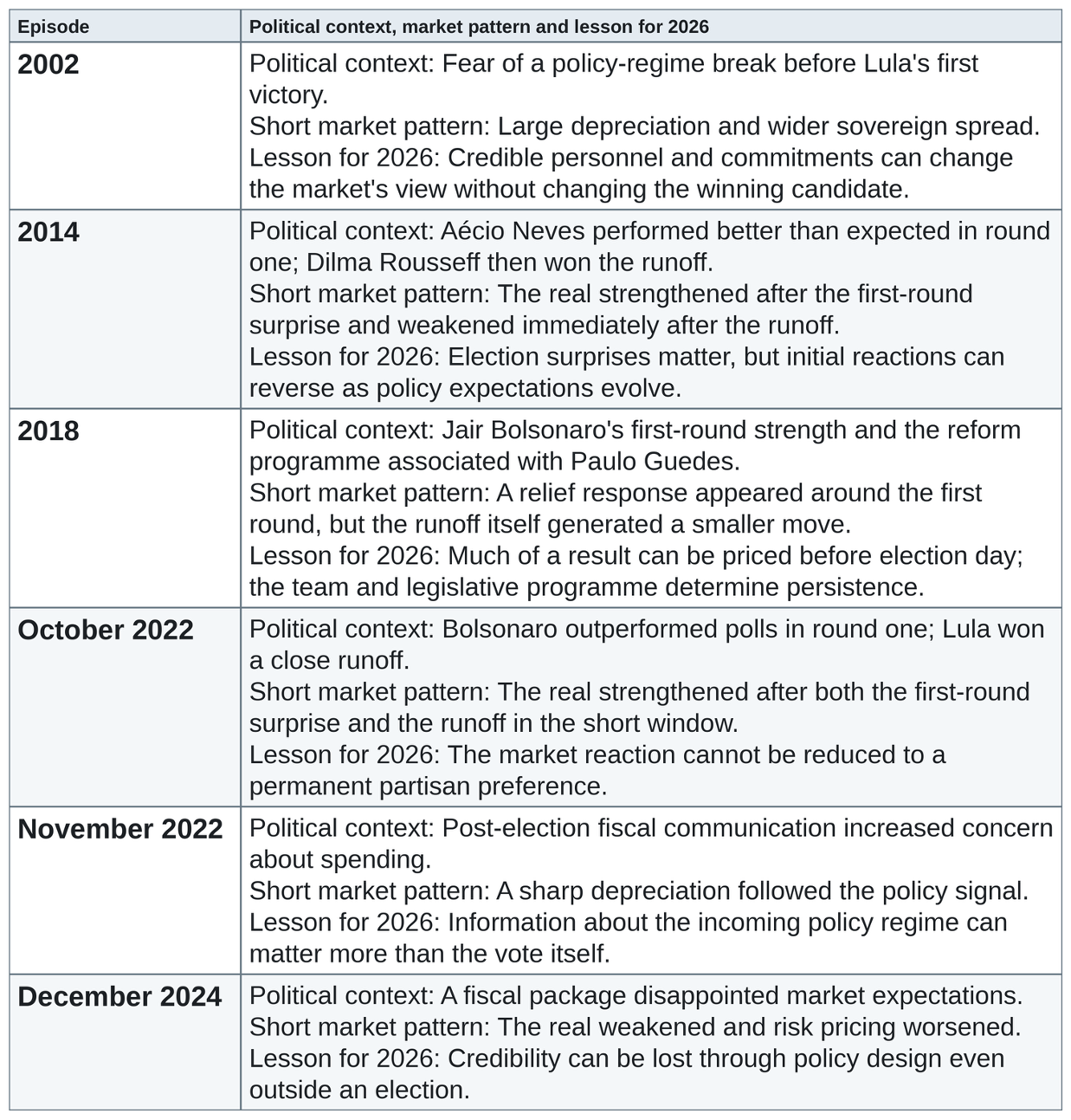
These episodes are not interchangeable. The 2002 case is the clearest example of regime fear and subsequent reassurance. The more recent cases are useful because they occur under institutions and market structures closer to those of 2026. Together they support a narrower claim: the BRL responds to surprises about policy credibility and implementation, and those surprises can arrive before or after the vote. [S020] [S021] [S022] [S023] [S105] [S106] [S107]
6. The political outcomes that can affect the real
6.1 The fiscal settlement
The fiscal question is whether the winner can construct a program that is funded, legally feasible and politically sustainable. An unfunded tax reduction can weaken the debt path just as an unfunded spending program can. Public banks and state-owned enterprises can also create fiscal exposure outside the headline budget.
· Will the existing fiscal framework be followed, transparently revised or repeatedly bypassed?
· Are campaign commitments financed by durable measures rather than optimistic revenue assumptions?
· What budget concessions will Congress demand in return for support?
· Will the economic team have enough authority to constrain its own coalition?
· Can the program survive the first budget vote and the first adverse economic shock?
The same tests apply to both camps. A Lula victory could support confidence if it is followed by funded adjustment and credible personnel, or weaken confidence if renewed authority makes expansion easier. An opposition victory could support confidence through fiscal discipline and de-escalation, or weaken it through unfunded tax cuts, subsidies, public credit or institutional conflict.
6.2 Congress: discipline, extraction or paralysis
Congress has become more autonomous over budget resources. Mandatory parliamentary amendments reduce the president’s ability to control every legislator through discretionary spending, while recent votes show that Congress can reject fiscal measures and Senate nominees. The next president may therefore need a different majority for the budget, taxes, central-bank legislation, appointments and trade responses. [S024] [S025] [S026]
The Senate seats being renewed are the class elected in 2018, which raises a plausible mean-reversion question because that election was unusually favorable to the right in many states. The article treats this as a qualitative structural hypothesis. The two-vote system, candidate retirements, party switching, coalition slates and local political machines require a state-by-state seat model before a numerical forecast would be defensible. [S002]
Constraint can improve credibility when it blocks an unfunded measure. Coalition bargaining can become extractive when support is purchased through opaque or costly concessions. Paralysis can initially prevent a weak policy but eventually create uncertainty if no budget, appointment or reform can pass. Conversely, a strong aligned majority can enable stabilization or make a weak program easier to execute.
6.3 Central-bank autonomy and the meaning of rates
Brazil granted the BCB operational autonomy in 2021, including staggered mandates that do not perfectly coincide with the presidential term. In June 2026, the Senate’s Constitution and Justice Committee approved a proposed constitutional amendment that would give the BCB greater control over its own budget and would recognize functions including monetary policy, financial stability and Pix. Committee approval was only an intermediate step: the proposal still required plenary approval in two rounds in the Senate and then the same constitutional process in the Chamber. If unresolved, the October congressional result will affect its fate. [S027] [S028] [S038]
The election can also affect future board nominations, Senate confirmation and public pressure on Copom. The market will care about the reason for a rate change. Easing can support the real when inflation is falling and fiscal credibility is improving; it can weaken the currency when investors see political pressure behind the decision.
6.4 U.S.–Brazil tariffs and the fiscal feedback loop
The initial U.S. Section 301 action imposed a 25% tariff with substantial product exemptions. Contemporary estimates placed direct exposure at roughly US$7–11 billion, or about 18%–26% of Brazil’s exports to the United States. Brazil then announced R$18.5 billion in credit for affected firms, including Treasury and BNDES resources. Even when loans are expected to be repaid, subsidized or state-backed support can create financing needs, contingent liabilities and pressure for wider compensation. [S030] [S032] [S042]
By the information cutoff, the United States had also finalized an additional 12.5% duty on covered Brazilian products, subject to separate exemptions and transit rules, effective early on 24 July. The actions cannot simply be added to every product because coverage differs. Politically, however, the second action raises the probability of prolonged confrontation and a larger domestic support program. The scenario model therefore modestly reduces clean stabilization and increases the weight on expansion or fragmentation. The adjustment is small and judgmental, and it is included in the sensitivity analysis rather than treated as a precisely measured electoral effect. [S098]
The transmission can run in a loop: tariffs reduce expected export income; affected sectors seek public support; support raises fiscal or quasi-fiscal exposure; a weaker fiscal outlook raises the sovereign-risk premium; and the real comes under additional pressure. The same tariff can also affect voter preferences through sovereignty and responsibility narratives, making it both an economic shock and a political input. [S005] [S008]
Pix enters this debate because it is public financial infrastructure operated by the BCB and has been cited in the trade dispute. Its direct exchange-rate importance is limited; its political significance is that it reveals how the next government balances domestic regulatory autonomy, foreign market access and relations with Washington. [S028][S029]
6.5 Transition disruption within the fragmentation scenario
Ordinary lawsuits, recount demands and harsh rhetoric fall within normal electoral conflict. A material transition crisis would involve refusal to recognize the official result, coordinated obstruction of the transfer of power, security-force involvement, sustained economic disruption or attempts to block essential appointments. Such a crisis belongs within the fragmentation scenario as an especially severe tail.
The available sample of domestic and foreign precedents is too small and judgment-dependent to support a precise public probability. The body therefore treats transition disruption as a low-probability qualitative tail. Appendix A preserves the selected-case stress calculation and its limitations.
7. Four possible governments
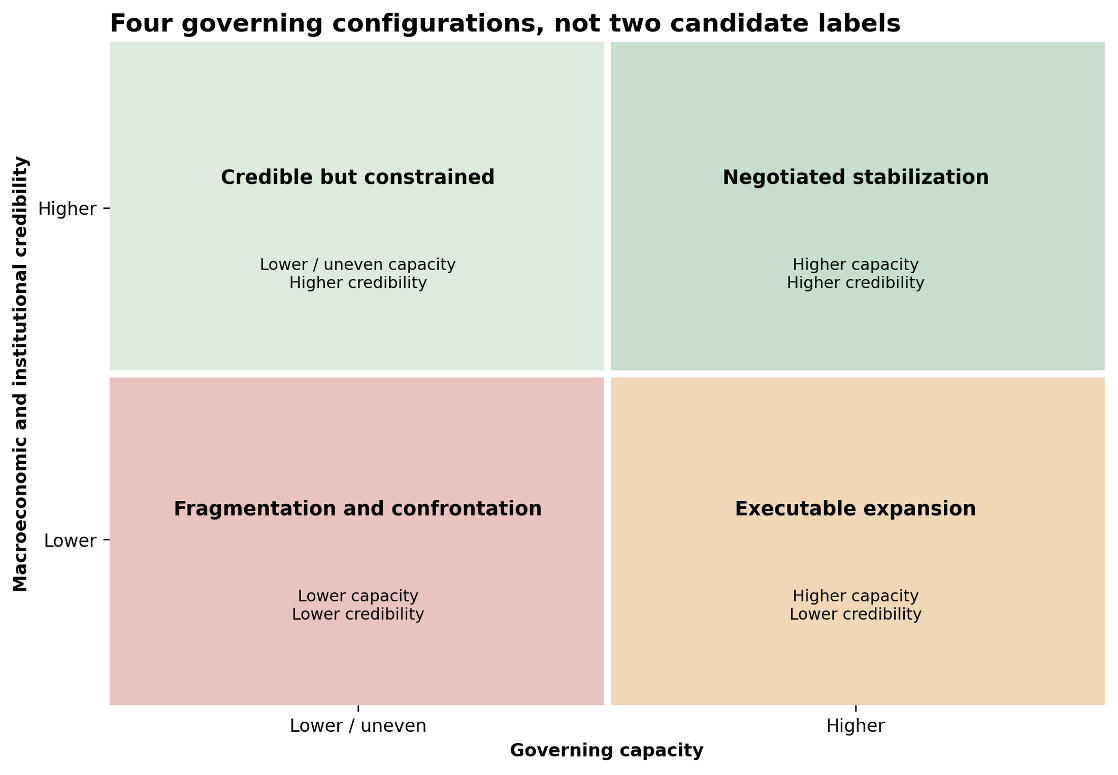
Figure 10. Four post-election governments defined by governing capacity and policy credibility.
How the probabilities were constructed
Six Brazilian administrations provide the domestic starting distribution. That sample is too small to populate all four configurations with confidence, so 13 foreign Latin American governments complement it. Each foreign case receives a lower or equal weight according to institutional similarity, the macroeconomic starting point and financial-market structure. The cases are coded on two questions: could the government act, and was its early policy direction macroeconomically and institutionally credible? Current candidate, congressional and tariff evidence then updates the starting distribution. Because a human analyst assigns the case labels, similarity scores and evidence multipliers, the result is a structured judgment with an audit trail. [S050]
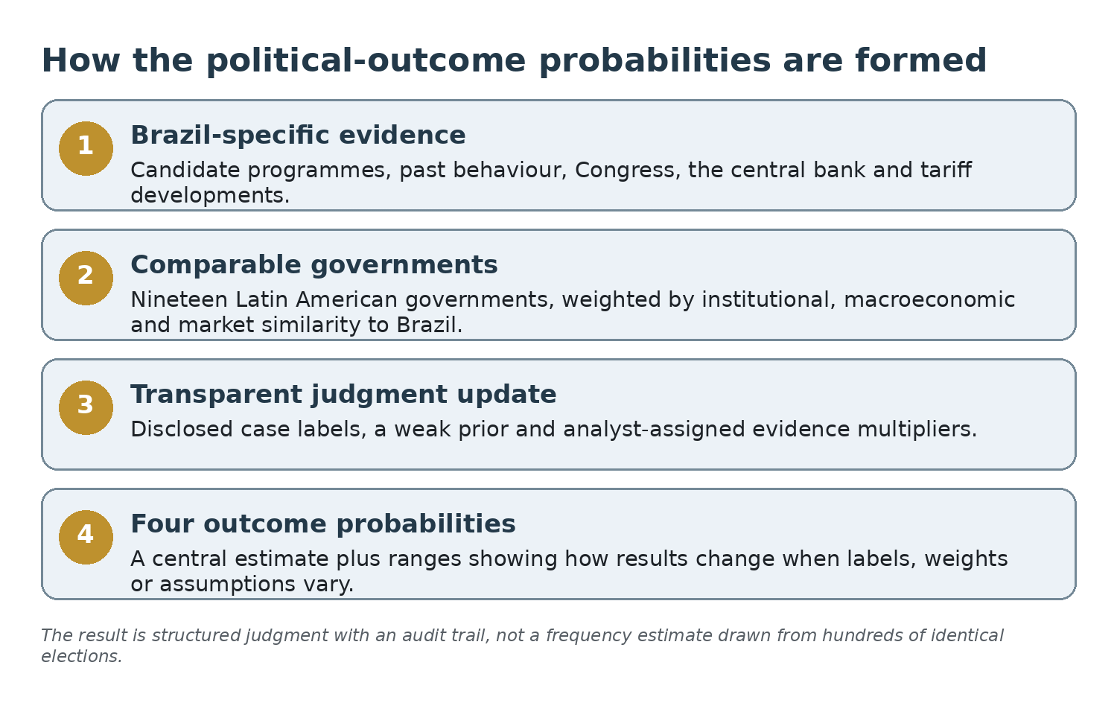
Figure 11. From comparable governments and current evidence to the four outcome probabilities.
The table below shows how those judgments affect the answer. ‘Best estimate’ uses the central coding and assumptions. ‘Several assumptions vary’ changes poll bias, case weights and evidence multipliers together. ‘One case removed’ tests whether a single historical government drives the result. ‘Disputed labels changed’ reclassifies contested cases such as Brazil 2019 and Argentina 2015. The ranges describe model dependence; a conventional statistical confidence interval would overstate what a 19-case, partly human-coded sample can support.
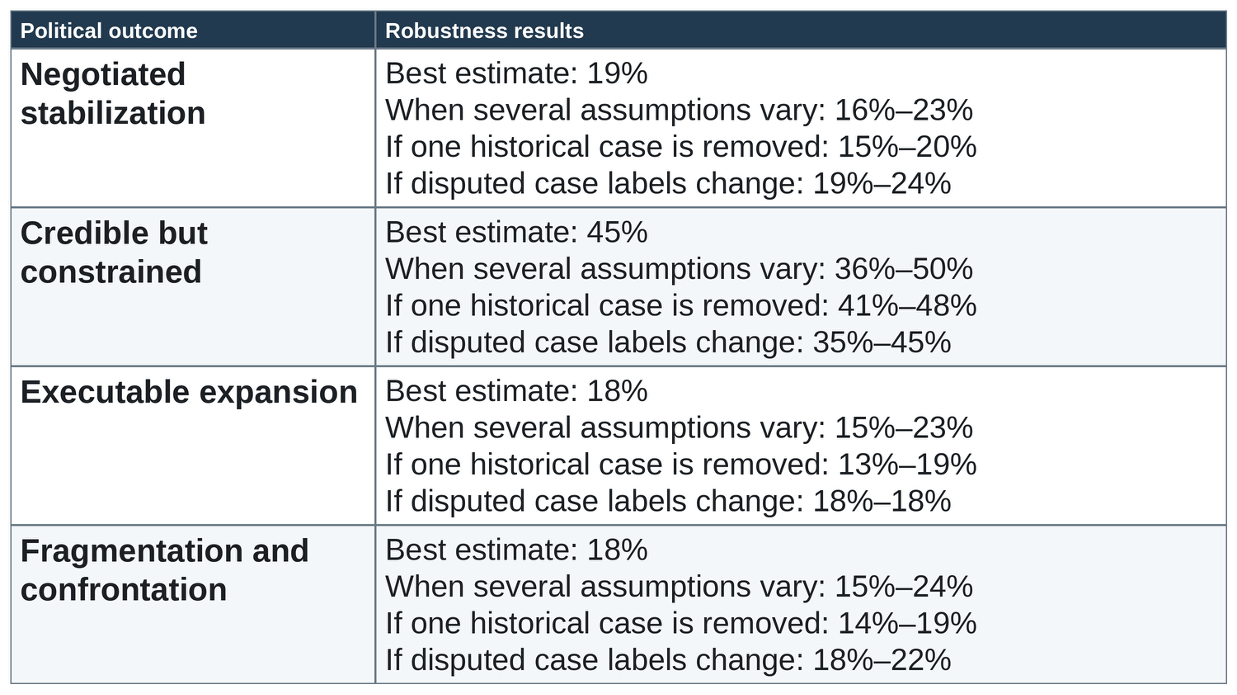
The constrained outcome remains the largest in every displayed central comparison, although its exact share moves materially. Plausible alternative coding lowers it to roughly 35%. The robust conclusion is the modal ranking; 45% should be read as the central structured judgment rather than a precisely measured historical frequency.
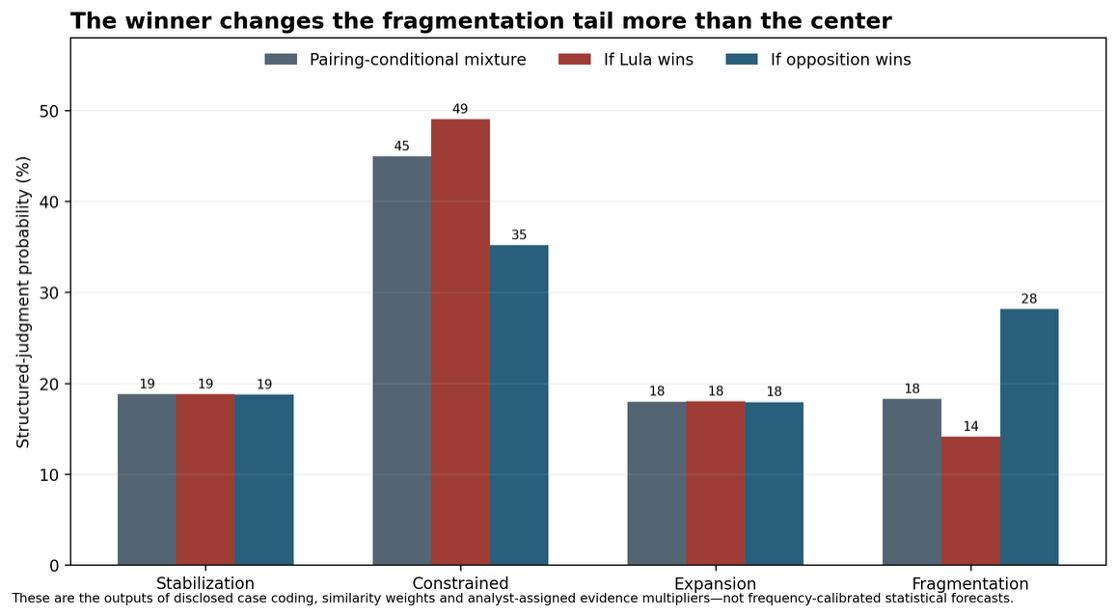
Figure 12. The presidential winner changes the fragmentation outcome more than the centre of the distribution.
Outcome 1: Negotiated stabilization—about 19%
The winner forms a workable coalition, narrows broad promises into funded commitments, appoints an empowered economic team, preserves BCB credibility and contains external-policy escalation. A Lula pathway would use the functional logic of 2002—costly commitments that bind the coalition—without assuming that 2026 will repeat the magnitude of 2002. An opposition pathway would require a funded programme, credible personnel, institutional restraint and trade de-escalation.
This is the most favourable domestic outcome for the real because a narrower sovereign-risk premium could reinforce Brazil’s high interest-rate carry. Global dollar strength or lower commodity prices could still overwhelm that domestic support.
Outcome 2: Credible but constrained—about 45%
The government avoids an immediate policy break but cannot implement a durable settlement. Congress blocks some weak measures and delays some necessary ones. Appointments become bargaining objects, budgets pass through transactional majorities and the economic programme survives only in partial form. This outcome can arise under either winner.
Constraint can be stabilising when it prevents an unfunded policy and destabilising when it prevents a credible adjustment. The likely market pattern is therefore repeated two-way repricing around budgets, appointments and fiscal announcements rather than a single lasting election-night trend.
Outcome 3: Executable expansion—about 18%
The winner obtains enough political capacity to implement a programme that weakens fiscal or monetary credibility. On the left, the mechanism could be spending without durable financing, public-credit expansion or pressure for faster easing. On the right, it could be unfunded tax reductions, subsidies, protection or costly security and industrial policies. The instruments differ; debt and inflation consequences can converge.
This outcome is easy to miss when governability is treated as automatically market-friendly. Execution capacity can amplify a weak programme just as easily as a strong one.
Outcome 4: Fragmentation and confrontation—about 18%
Weak capacity and weak credibility reinforce one another. Coalition formation stalls, the fiscal programme remains vague, appointments are delayed, relations with Congress or the courts deteriorate and external conflict escalates. The outcome does not require a constitutional rupture; several smaller failures can stack risk premiums at the same time.
Material transition disruption forms a low-probability stress within this outcome. Appendix A retains the selected-case calculation. The public conclusion is qualitative: an opposition transfer creates more uncertainty around coalition-building, courts and the administrative handover than continuity under an incumbent, while leaving ample room for a disciplined right-of-centre administration.
The most likely path
The central path is an electoral winner who can prevent immediate deterioration but cannot impose a fully coherent programme on Congress. The first achievement of the next administration would therefore have to be political construction: creating a coalition that accepts both the benefits and the costs of the fiscal programme. That outcome is more likely than either a clean stabilization mandate or an unrestricted expansionary mandate.
8. Combined scenario-conditioned pressure on the real
8.1 Combining the measured sovereign-risk effect with other domestic channels
This section estimates the combined distribution of domestic political pressure associated with each governing configuration while the broad dollar, peer emerging-market currencies and Brent oil are held at the same baseline. Positive values mean depreciation pressure; negative values mean appreciation pressure. The main plot does not present sovereign risk as though it will operate alone. Each scenario’s measured sovereign-risk effect anchors the median, and same-horizon historical residual variation is added to represent uncertainty from expected rates, inflation compensation, local yields, capital flows, BCB intervention, positioning and liquidity, together with coincident domestic news. The political probabilities remain separate from the currency distributions because the complete chain has not been validated as one joint model.
Sovereign risk is the premium investors demand to hold Brazilian government debt. Political news can raise that premium when it worsens expectations for debt, inflation or institutional stability; wider spreads can reduce demand for real-denominated assets and increase hedging or capital outflows. The EMBI spread supplies the measurable anchor because a long daily history and comparable political events are available.
The other channels can move at the same time and can reinforce or offset the spread effect. Estimating each one separately would require consistent daily data and enough political events to identify scenario-specific shocks without counting the same fiscal news several times. The combined distribution therefore adds a median-centred draw from the same-horizon domestic residual to the sovereign-risk draw. That residual is an uncertainty proxy, not a claim that every unexplained historical move was caused by politics.
8.2 Why the analysis remains conditional
A preliminary forward test asked whether lagged changes in the broad dollar, peer currencies, Brent, Brazil’s EMBI spread and the policy-rate differential could predict the next four-week BRL return. The test found no forecasting advantage over simple benchmarks. The analysis below therefore conditions on a specified political sovereign-risk shock and does not claim a general currency-forecasting edge. Appendix A reports the diagnostic.
8.3 From governing configurations to the combined BRL distribution
The first component starts with dated Brazilian political and fiscal events and measures the change in Brazil’s EMBI spread relative to the Latin American EMBI index. The central samples contain four stabilization events and three events each for credible constraint, executable expansion and fragmentation. Each event begins when the governing configuration or policy signal became reasonably visible, which may precede a formal inauguration or enactment date.
Foreign evidence is used to complement domestic evidence, but only in specific cases. The Brazilian event sample remains the starting point. Foreign cases enter when at least four comparable countries show a strong directional or near-zero consensus and the conclusion survives leave-one-country-out checks. Only the credible-but-constrained configuration passes that gate. The other three scenarios rely on Brazil because a few dramatic foreign episodes would otherwise carry too much weight.
After controlling for the broad dollar, an equal-weighted MXN–ZAR–INR basket and Brent, a 100-basis-point Brazil EMBI widening is associated with approximately 3.4% BRL depreciation over five trading days and 4.8% over twenty trading days. That association anchors the median scenario effect. The public distribution then adds the historical scale of the remaining domestic response, so the chart represents the combined outcome rather than a sovereign-risk-only result. EMBI and USD/BRL can react jointly to the same news, so the coefficient remains a historical sensitivity rather than a causal multiplier.
8.4 Combined five- and twenty-day impact distributions
The table and Figure 13 report the combined distribution. The point estimate is the scenario median anchored in the measured sovereign-risk effect. The 10th–90th percentile range adds a median-zero draw from the same-horizon domestic residual after the broad dollar, peer currencies, Brent and EMBI have been accounted for. The result therefore places the estimated spread effect and the uncertainty from other election-sensitive domestic channels in the same distribution. It is not a classical confidence interval and does not attribute every residual move to the election.
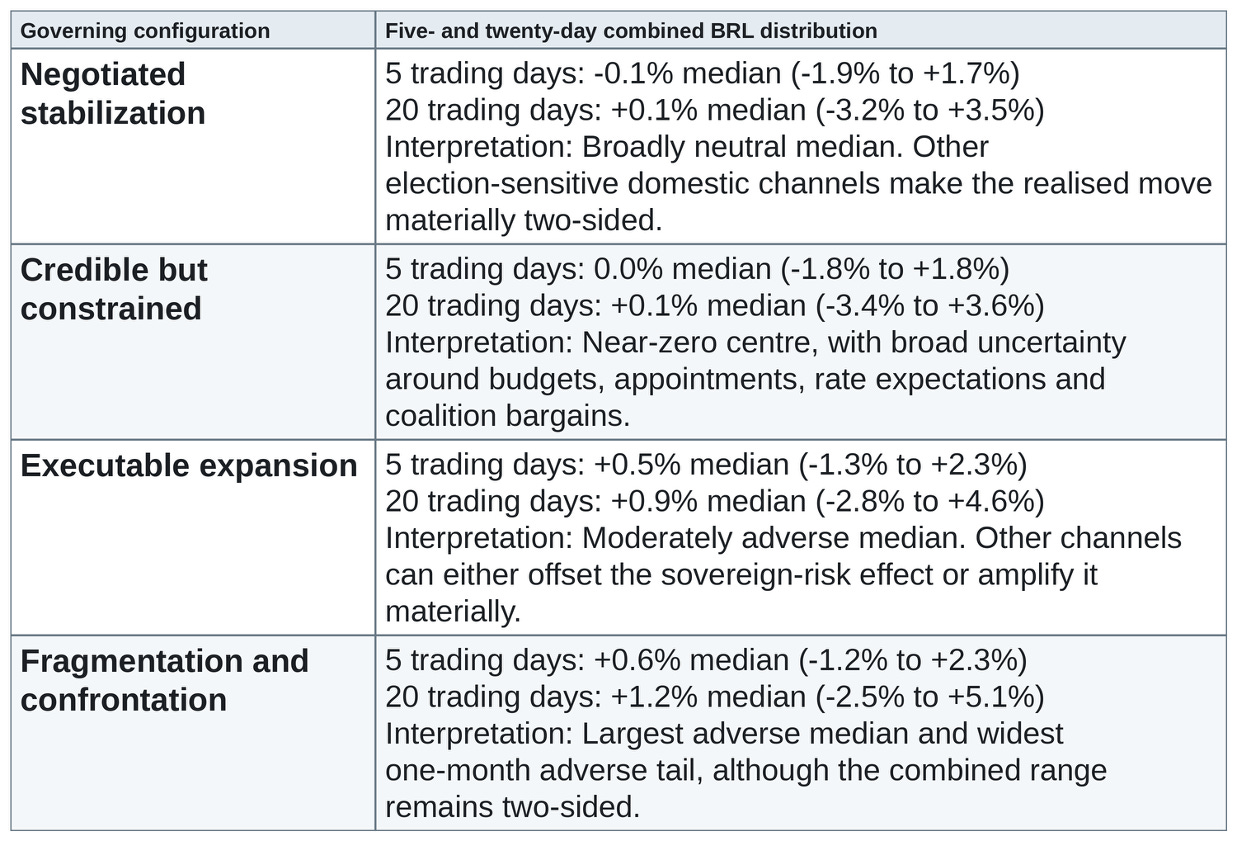
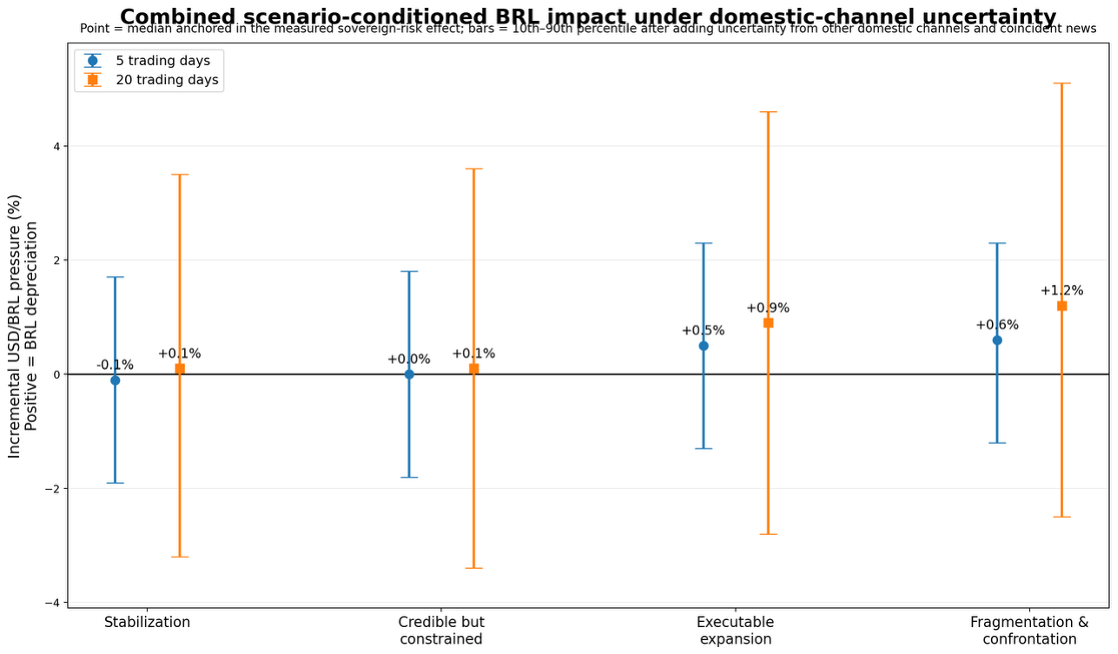
Figure 13. Combined scenario-conditioned BRL impact at five and twenty trading days. Points show the median anchored in the sovereign-risk effect; bars show the 10th–90th percentile distribution after adding uncertainty from other domestic channels and coincident news.
Fragmentation retains the largest adverse median and the widest one-month adverse tail. Executable expansion is also adverse at the centre, while stabilization and credible constraint remain close to neutral. Once the other domestic channels are added, however, every displayed range is two-sided. The defensible conclusion is therefore an ordering of central pressure and adverse-tail size—not certainty that the observed BRL move will have the same sign as the sovereign-risk component.
How to interpret the combined bands
The combined bands prevent the measured sovereign-risk effect from being presented in isolation. They retain its scenario-specific median and add the historical dispersion of the other domestic response at the same horizon. This is the closest available approximation to how the channels will operate jointly in reality. The trade-off is that the added variation cannot be decomposed cleanly into rates, inflation expectations, flows, intervention, positioning or liquidity, and it also contains coincident Brazilian news not caused by the election.
8.5 What the combined distribution does and does not establish
The combined distributions are more realistic than a sovereign-risk-only plot because they allow other domestic channels to move at the same time. They remain uncertainty distributions rather than clean causal estimates. The median is scenario-specific because it comes from the political-event-to-EMBI calibration; the additional width is historical residual variation and cannot reveal which channel produced a particular deviation. A larger event library and daily real-time rate, inflation and flow data would be required for a defensible channel-by-channel decomposition.
The main discussion stops at five and twenty trading days. Appendix A retains the sixty-day persistence test, LOWESS mapping, historical financial buckets, full diagnostics and event-level methodology for transparency.
8.6 How the results will be graded
The post-election grading note will compare the realised five- and twenty-trading-day Brazil EMBI change and external-control-adjusted BRL return with the published ranges, using the first complete archived data vintage and reporting raw USD/BRL separately. Appendix A sets the calendar and vintage rules. The note will be published regardless of the outcome, and a range hit will count as descriptive consistency rather than proof that the election caused the full currency move.
9. What would change the assessment
Conclusion
The current-field model gives Lula an expected first-round valid-vote share of about 45.7%, a 15.7% chance of winning outright in the first round, a 70.4% chance of becoming president through the runoff conditional on a runoff being required, and a 74.7% unconditional presidency probability. Flávio’s corresponding values are 36.6%, 0.3%, 29.6% and 25.1%. Renan is about 0.2% unconditionally, while Caiado, Zema, Cury and the aggregate residual category remain below 0.1%. The 3.5–6.5-point width sensitivity places Lula at 72.8%–78.8% and Flávio at 21.2%–26.6%; alternative composition and residual-pool specifications at the five-point width place them at 74.5%–76.1% and 23.9%–25.1%. These are current-field model outputs, not fixed truths, and the tree must be rebuilt after a substitution, withdrawal or material field change.
The more durable conclusion concerns government formation. Brazil will choose a president, an entire Chamber, two-thirds of the Senate, governors and state legislatures on the same day. The most likely outcome in the disclosed framework is a credible-but-constrained government: functional enough to avoid an immediate break, but too divided to deliver a complete fiscal and institutional settlement without repeated bargaining.
The currency exercise estimates incremental domestic political pressure without imposing an absolute spot target. Its main output is a combined distribution: the measured sovereign-risk effect anchors each scenario’s median, while uncertainty from the other domestic channels is added to the same draw. The twenty-day medians are approximately +0.1%, +0.1%, +0.9% and +1.2% for stabilization, constraint, expansion and fragmentation. The corresponding 10th–90th percentile ranges are roughly -3.2% to +3.5%, -3.4% to +3.6%, -2.8% to +4.6% and -2.5% to +5.1%.
Those ranges are wider and more realistic than the sovereign-risk component alone, but they are not a promise that every movement inside them will be election-caused. Actual USD/BRL returns will also reflect global markets and coincident domestic news. The vote can set the opening price; the coalition, fiscal programme and institutions that emerge will determine whether the move persists. Brazilian voters will choose a president in October. The real will wait to learn whether they have also chosen a government.
Appendix A. Quantitative methods and updating logic
A1. What each numerical layer means
A2. Poll-model mechanics and updating logic
The accompanying Python script expects one row per poll, including the polling organisation, Lula and Flávio toplines, sample size, fieldwork dates, publication timestamp, national scope, runoff question, source URL and a valid TSE registration. Mode and sponsor are optional. The validator applies the information cutoff, the 45-day lookback and the latest-wave-per-organisation rule.
· Add or replace qualifying poll rows without changing the field definitions.
· Change the information cutoff only when intentionally creating a new data vintage.
· Run the accompanying script to regenerate the pooled share, historical error calibration and sensitivity results.
· Recalculate the government probabilities whenever the runoff pairing or close-margin distribution changes.
· Regenerate the tables and figures after every substantive update.
· Record the input cutoff, fixed random seed and source URLs with each published update.
For poll i, the two-candidate share is pᵢ = Lulaᵢ/(Lulaᵢ+Flávioᵢ). The model pools logit(pᵢ) using approximate within-poll sampling variance plus a DerSimonian–Laird between-poll variance. Recency weights decay with a 30-day half-life. The common remaining-error shock follows a Student-t distribution with five degrees of freedom and the selected standard deviation. The script uses a fixed random seed and retains the historical-error, universe and pollster-sensitivity calculations.
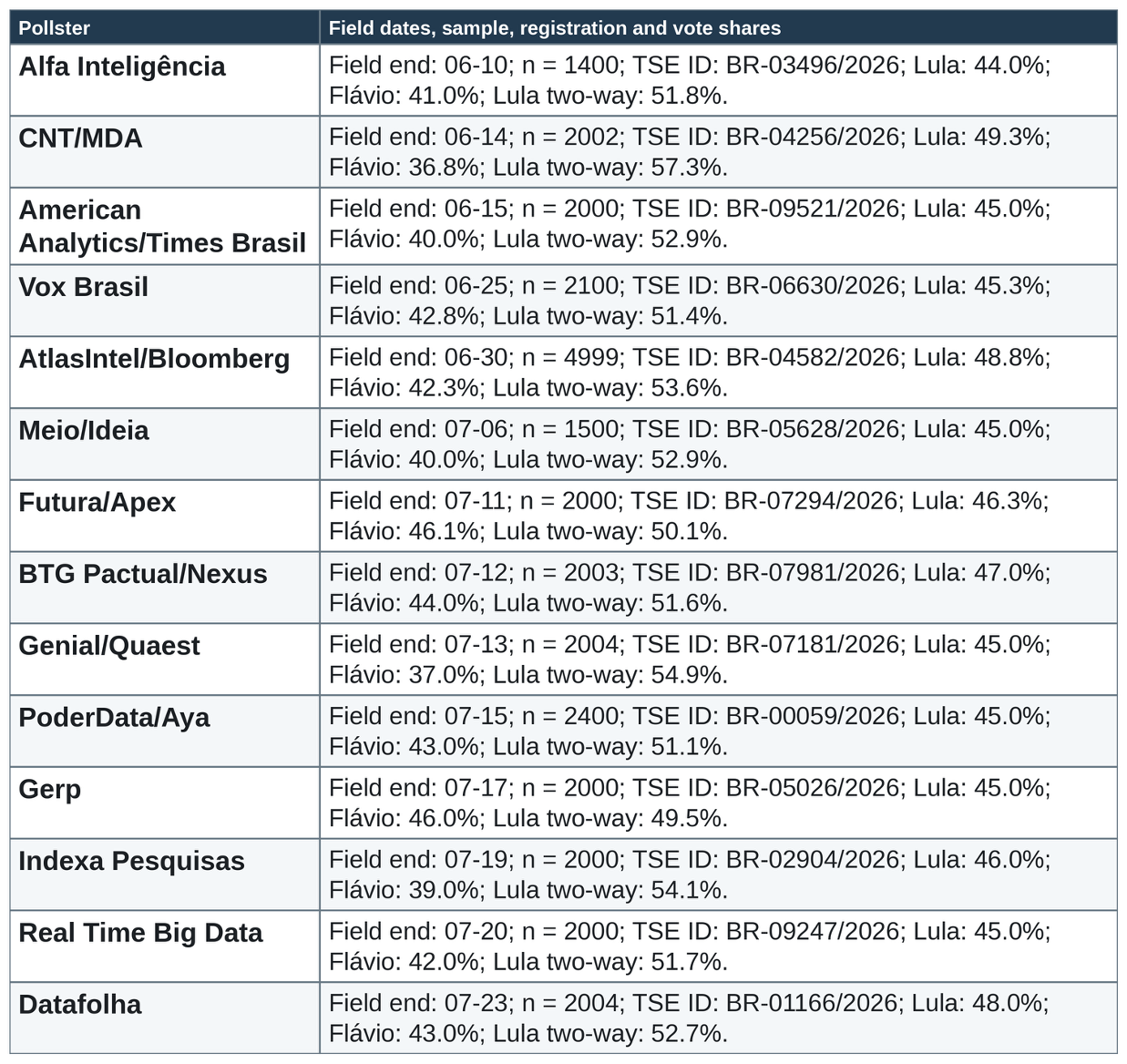


The posterior predictive mean error is +0.11 points, with predictive standard deviation 0.66. Positive error means that final polls overstated the left candidate. At the five-point total width, the bias-integrated result is 70.4%; a symmetric comparison centred at zero gives 71.4%. Five elections leave substantial uncertainty around the historical mean.
A2.1 Distribution choices and the five-point baseline
Current-poll uncertainty is approximated as normal on the log-odds scale. For the common remaining error, the baseline assumes one centre, symmetry around that centre and declining probability as the absolute shock grows. Those properties encode the judgments that small departures from the pooled estimate are more likely than large ones and, after the separate directional-bias adjustment, that equal-sized pro-Lula and pro-Flávio errors are equally plausible. The five-point baseline is the standard deviation of this common shock in percentage points of the final two-candidate vote; 3.5 and 6.5 points provide narrower and wider alternatives.
The broader distribution choice is constrained by the available evidence. Uniform and triangular laws require arbitrary bounds; skewed laws require evidence of directional asymmetry; mixture distributions require identifiable regimes and mixing probabilities; and an empirical distribution requires far more lead-time-matched elections. Within the remaining family of symmetric, single-peaked distributions, the Student-t with five degrees of freedom is used because it has finite variance, an interpretable scale and thicker tails than the normal. Other symmetric heavy-tailed laws could also be defensible, so this is a modelling convention rather than a proven fact. The reported width sensitivities and directional mean-shift stresses test the most decision-relevant departures from that convention.
A2.2 Current-field first-round, runoff and unconditional probability tree
The first-round layer uses 11 latest qualifying national full-field polls. It converts each poll to valid-vote shares, applies a 30-day recency half-life, estimates cross-pollster covariance in centered-log-ratio space and simulates a multivariate Student-t campaign shock. The historical +0.11-point left-candidate overstatement mean is implemented as a log-odds tilt before the softmax. A deterministic common-random-number least-squares routine solves the six independent location coordinates, the campaign scale and the residual-pool multiplier so that the bias-adjusted mean composition is reproduced, Lula’s final share has the declared 3.5-, 5.0- or 6.5-point standard deviation and the central aggregate Other pool has a 2.0-point standard deviation. The central model divides Other among four anonymous candidates and includes them when selecting first-round winners and finalists; higher-volatility, concentrated and single-candidate treatments are sensitivity cases. Every draw is asserted to be finite, non-negative, no greater than one and to sum to one. Pairwise runoff probabilities are estimated from current matchup polls using recency-weighted random-effects pooling and the declared total-error assumptions. The Lula–Flávio branch is 70.4% for Lula. Direct Lula-versus-opponent polls imply Lula win probabilities of about 79.8% against Caiado, 86.4% against Zema, 95.5% against Renan and 98.9% against Cury. Rare non-Lula named pairings use a Bradley–Terry interpolation; anonymous residual matchups use a neutral 50% central assumption with 35%–65% sensitivity. The baseline produces P(runoff required) = 83.9% and P(Lula–Flávio pairing | runoff) = 99.2%. The resulting unconditional estimates are Lula 74.7%, Flávio 25.1%, Renan about 0.2%, and the remaining named and residual categories below 0.1%. [S127] [S128]
No coordinate system is treated as uniquely neutral. At the five-point width, the supplement therefore compares the central logistic Student-t composition with a logistic-normal model, a Dirichlet composition, a higher-volatility residual pool, a single-residual-candidate upper bound and 35%–65% unidentified residual-runoff matchup assumptions. Across these alternatives, Lula’s unconditional probability ranges from 74.5% to 76.1%, Flávio’s from 23.9% to 25.1%, and the residual category remains below 0.2%. These are model-dependence checks rather than confidence intervals.
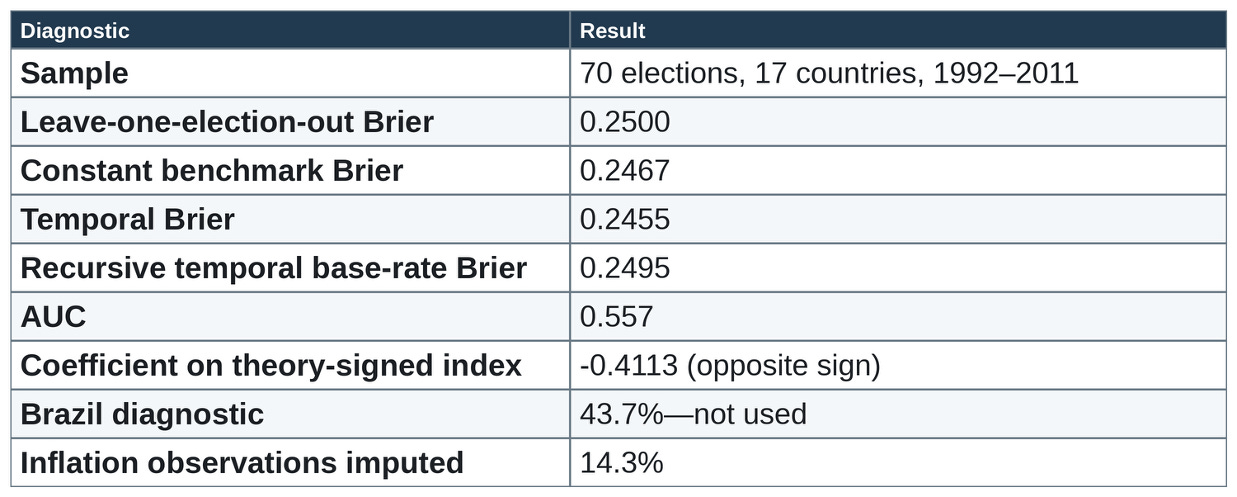
A3. Exploratory fundamentals diagnostic
The fundamentals exercise is included only as a diagnostic. Its target is a formal executive-party continuation proxy in a 1992–2011 Latin American sample, not Lula’s victory, coalition continuity or ideological-camp retention. The fitted coefficient on the theory-signed index is negative, its leave-one-election-out Brier score is worse than the constant benchmark, and its AUC is only modestly above 0.5. It therefore has zero weight in the presidential estimate.
A4. Scenario construction and robustness
The prior adds a 0.5 pseudocount to each outcome before applying similarity-weighted historical counts. Six Brazilian administrations form the domestic core; 13 foreign cases complement it. Candidate-specific likelihood ratios and the current-evidence multiplier are disclosed in the accompanying script. Robustness varies poll bias, case weights, likelihood ratios, prior strength, individual case inclusion and alternative labels. No independent second coder was available. The prospective codebook excludes market outcomes from the political labels and specifies blind double-coding, adjudication and weighted kappa before the reference class can be treated as independently validated.
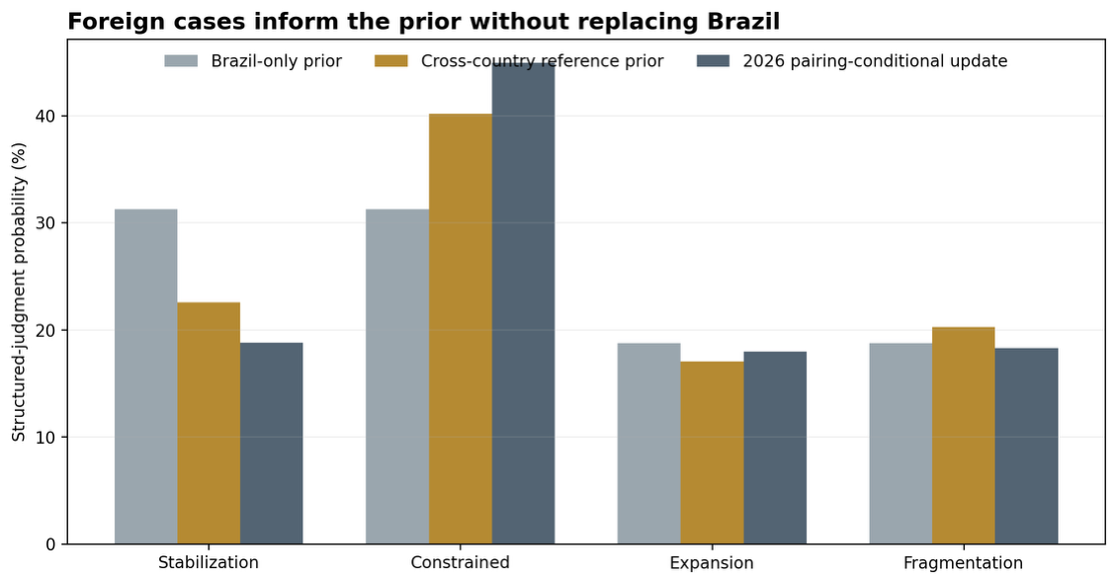
Appendix Figure A1. Brazil-only starting distribution, cross-country reference class and the 2026 update.
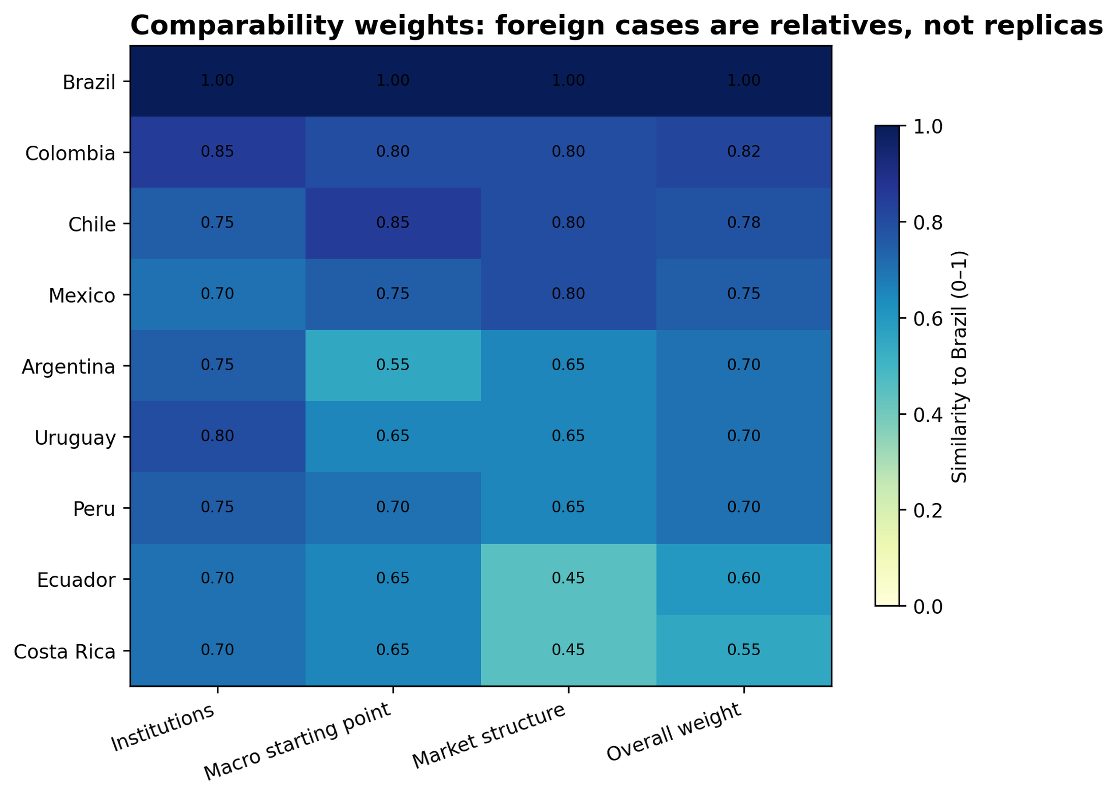
Appendix Figure A2. Similarity weights used to borrow foreign evidence without treating countries as identical.
A4.1 Transition-disruption stress estimate
As a technical stress test, the selected close- or disputed-election reference class contains strict disruption in 2 of 13 cases. Conditioning that rate on the poll model’s probability of a decisive-round margin below five points and applying disclosed uncertain Brazil-specific adjustments produces a central stress component of approximately 2.3%, with a 90% simulation range of roughly 0.6%–5.7%. It remains nested within fragmentation. The universe is purposive, labels were not independently double-coded and the Brazil adjustments are analyst distributions, so the value is not a calibrated unconditional probability and is not used as a headline estimate.
A5. Scenario-conditioned BRL equations, diagnostics and appendix-only robustness
For horizon h, the dependent variable is 100 times the log change in USD/BRL; positive values mean BRL depreciation. The central regression controls for the broad-dollar return, an equal-weighted MXN–ZAR–INR return and Brent, then estimates the same-window association with Brazil’s EMBI change. A separate specification tests the actual monthly Brazil–U.S. policy-rate differential. That series is too coarse to represent the daily market-implied rate path, so it remains a diagnostic rather than the central political shock.
For scenario s and horizon h, the partial impact equals the horizon-specific EMBI coefficient multiplied by the scenario-specific regional-adjusted Brazil EMBI change, with external-control contributions fixed at zero. The simulation propagates coefficient uncertainty and limited robust event jitter. Five- and twenty-day outputs are the primary estimates; sixty-day results remain exploratory.
A5.1 Combined distribution for sovereign risk and other domestic channels
For scenario s and horizon h, the public combined draw is Iₛ,ₕ = βₕΔEMBIₛ,ₕ + eₕ, where the first term is the scenario-specific sovereign-risk contribution and eₕ is a median-centred resample of the same-horizon domestic residual after the broad dollar, peer currencies, Brent and EMBI have been accounted for. This construction adds the measured spread effect to the historical uncertainty from other domestic channels rather than displaying the spread channel in isolation. The residual also contains coincident domestic news, so the combined distribution is an uncertainty gauge and not a causal election-effect decomposition.
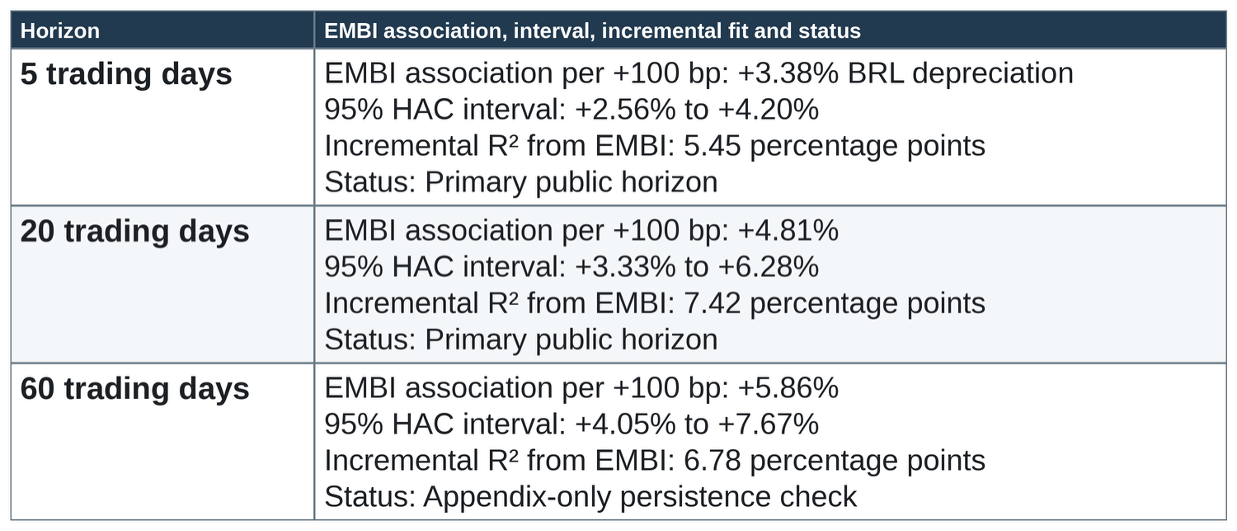
A5.2 Exploratory sixty-day scenario results
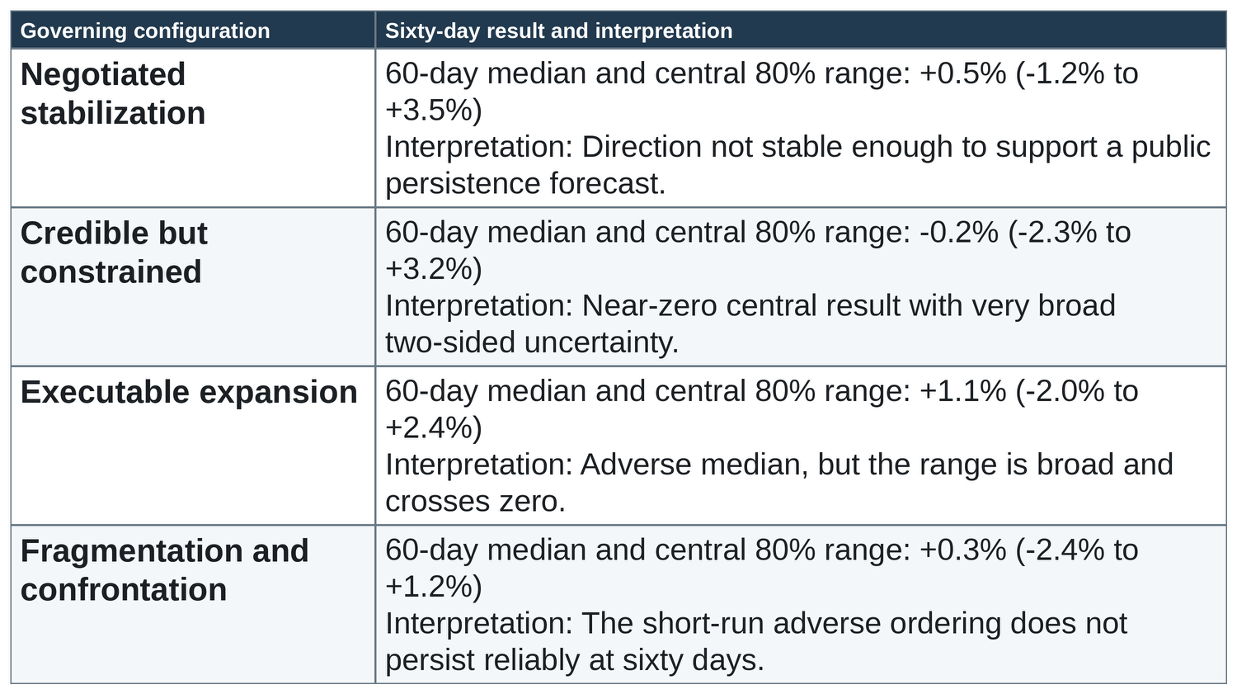
By sixty trading days, cabinet formation, budgets, monetary expectations and unrelated global developments increasingly contaminate the initial political signal. The results are therefore reported for transparency and future grading, not as a primary forecast.
A5.3 LOWESS and historical financial buckets
The LOWESS mapping checks whether the linear ordering survives a flexible smoother. Its shape depends on the smoothing span, block length and sparse tail observations. The named historical buckets are communication aids that summarise external-control-adjusted returns in parts of the fitted sovereign-risk distribution; they do not identify political causes.
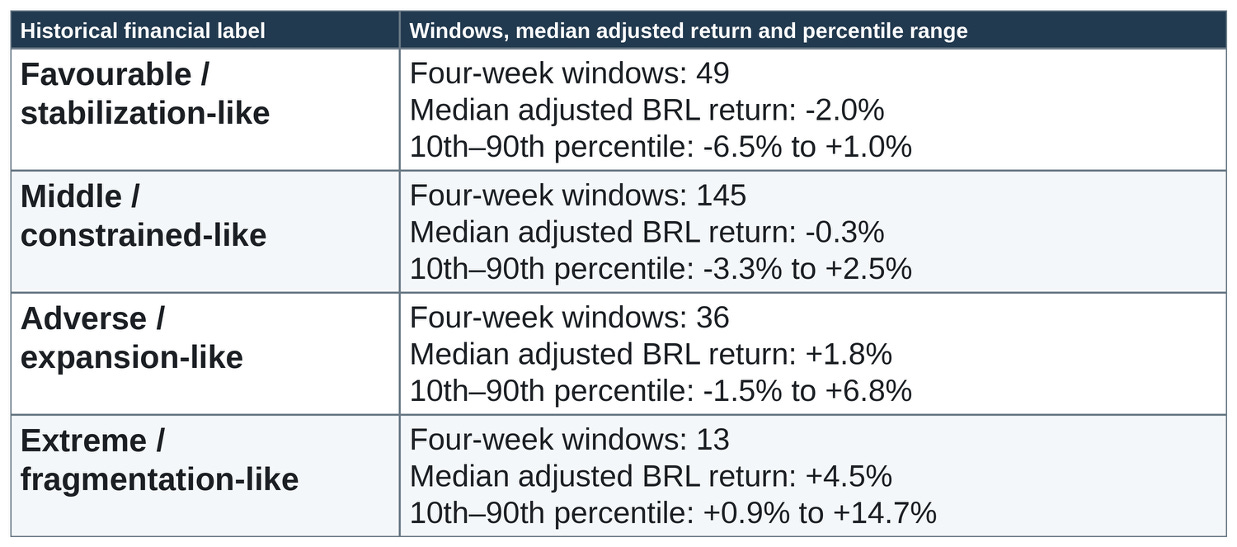
These realised-return distributions are much wider than the central partial estimates because they include unexplained Brazilian shocks and other domestic channels. They provide stress context alongside the explicit residual envelope.
A5.4 Event samples, foreign evidence and omitted channels
The central event calibration contains four stabilization events and three Brazilian events for each of the other scenarios; the constrained scenario also uses diversified foreign evidence. The samples remain small, and expected rates, inflation compensation, local long yields, portfolio flows, intervention, positioning and liquidity are omitted or incompletely measured. The accompanying script reproduces the event rows, leave-one-country checks, model fits and sensitivity calculations.
A6. Frozen five- and twenty-day grading and resolution rules
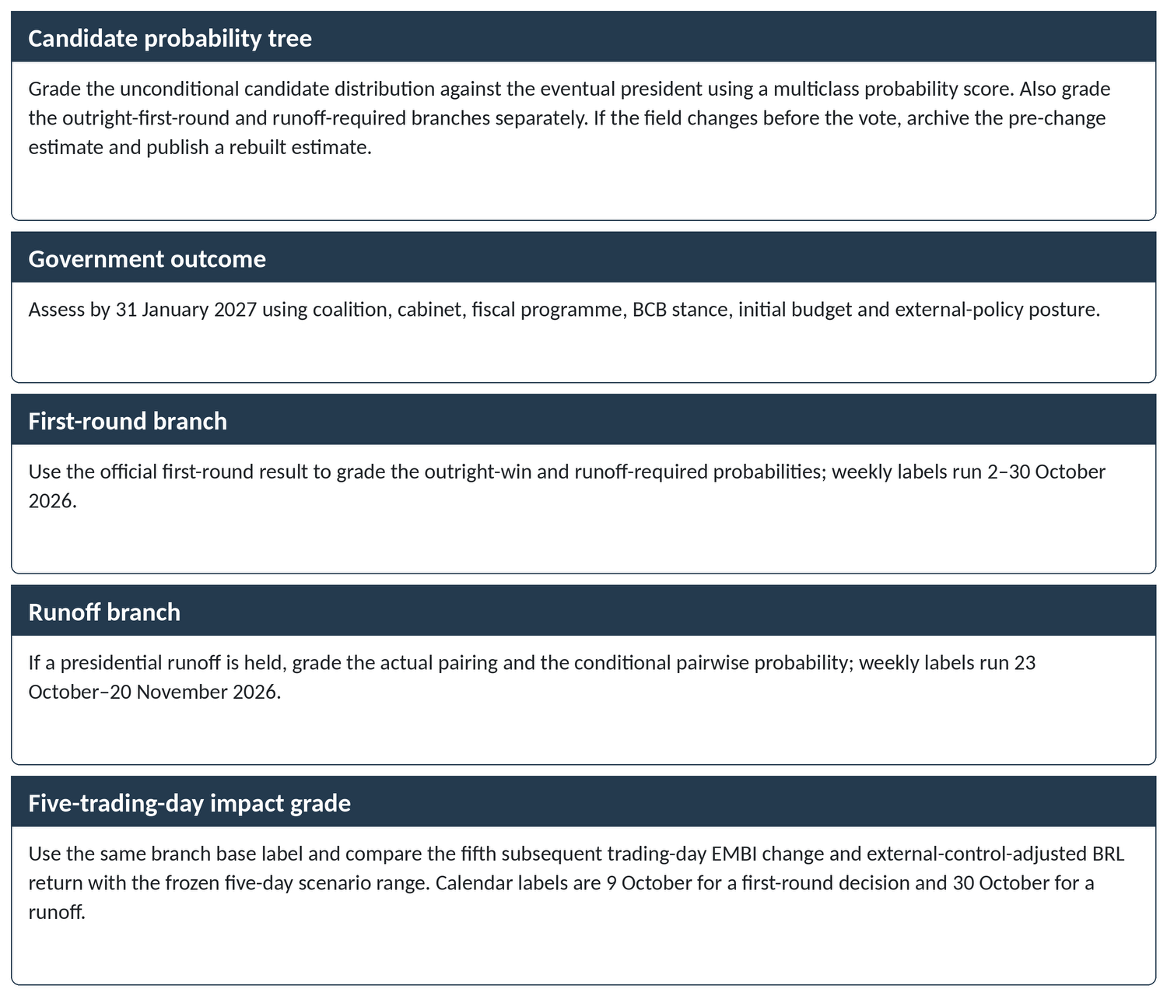
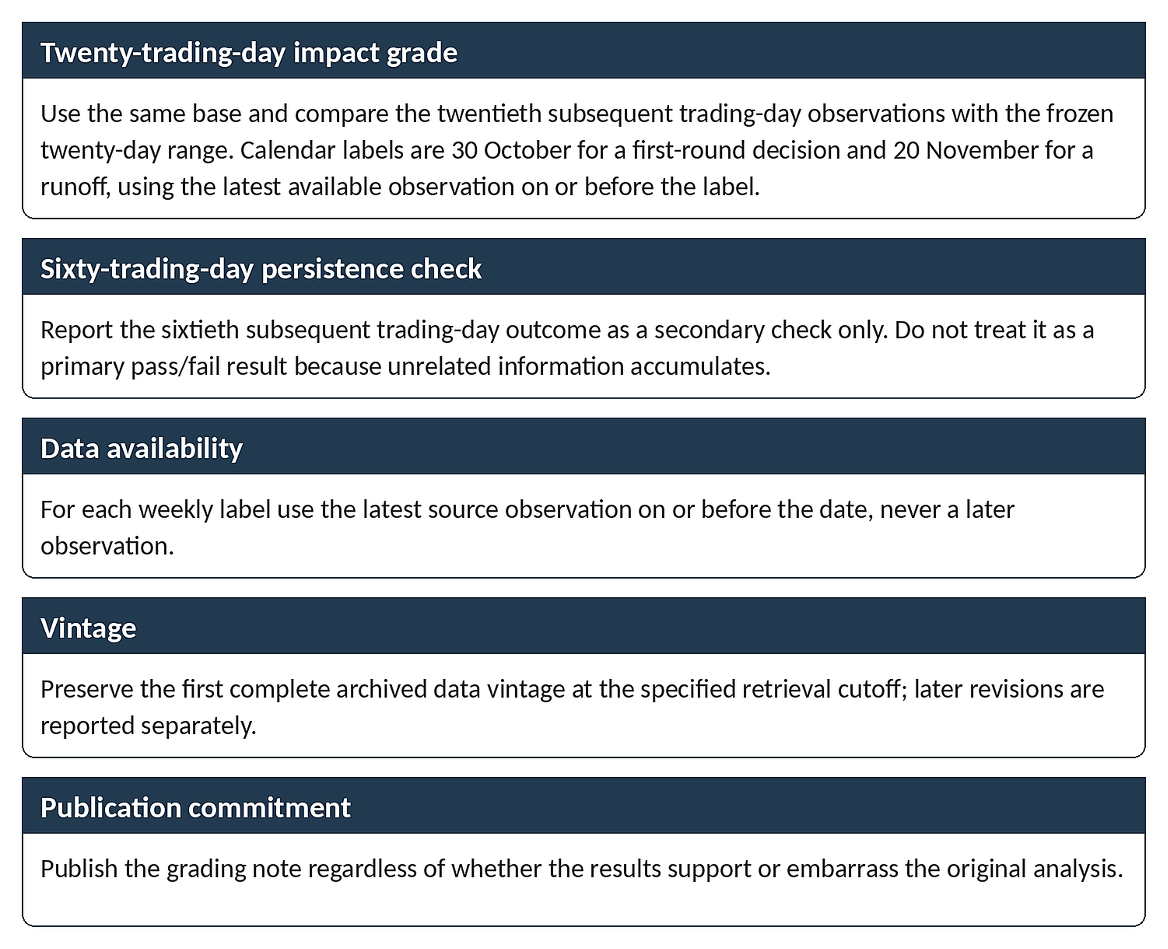
A7. Market comparisons and modular-model governance
Prediction markets remain a separate comparison. They may be displayed when the contract resolves the same event, liquidity and concentration are disclosed, and the data-vintage timestamp is preserved. Any minimum-liquidity threshold is a governance choice whose historical accuracy still requires validation.
An FX forward mainly reflects carry, funding conventions and no-arbitrage relationships. It can provide market context, although it should not be read as the market’s expected future spot rate or substituted for the historical BRL analysis.
The poll, government-configuration, financial-condition and BRL layers remain modular. A single posterior will only be considered after each transition has a validated error model and genuine out-of-sample evidence. Two graded election cycles would be a minimum observation threshold for reconsideration, not sufficient validation on their own.
Appendix B. Sources and reproducibility
The article distinguishes directly cited sources, model inputs, data lineage, methodological references and cross-checks. Publication dates, observation vintages, source URLs, transformations and material limitations are recorded in the source notes and accompanying files. The candidate-probability supplement contains the frozen first-round and pairwise poll inputs, candidate-level output table, pairwise probability matrix, model summary and reproducible Python script.
The candidate-probability script uses fixed random seeds and regenerates the current-field tree under the 3.5-, 5.0- and 6.5-point total-error assumptions. The publication values are rounded for communication, so very small Monte Carlo differences can occur if simulation counts or numerical libraries change. Office and PDF rendering may also vary slightly across software even when numerical content is unchanged.
Core current sources
S001. Brazil 2026 electoral calendar — Convention, registration, first-round, runoff and inauguration dates.
S002. Offices contested in the 2026 election — 513 Chamber seats and 54 of 81 Senate seats.
S003. BTG Pactual/Nexus presidential poll, July 2026 — Poll-model input: Lula 47%, Flávio 44% in the hypothetical decisive round; sample, mode, field dates and TSE registration.
S005. Genial/Quaest July 2026 poll and tariff-response questions — Runoff and first-round top lines; tariff-related voter response; sample and field dates.
S006. AtlasIntel/Bloomberg presidential poll, June 2026 — Poll-model input: Lula 48.8%, Flávio 42.3%; n=4,999; Atlas RDR fieldwork June 26-30; TSE BR-04582/2026.
S013. Monetary Policy Report, June 2026 — Growth, inflation, policy outlook, fiscal-monetary linkage.
S014. Fiscal statistics, May 2026 — Primary/nominal balance, debt and interest burden.
S015. Inflation indicators — June 2026 IPCA reading.
S017. Brazil move to floating exchange rate in 1999 — Documents the timing of Brazil’s transition to a floating exchange-rate regime and the institutional background relevant to the 2002 comparison.
S018. IMF approves US$30.4bn stand-by arrangement, 2002 — Part of the 2002 stabilization sequence.
S020. 2018 post-election real rally faded — Shows implementation questions after ideological relief rally.
S021. Brazilian assets after Lula 2022 victory — Immediate orderly-transition market response.
S022. Lula spending comments end 2022 market honeymoon — Post-election fiscal communication shock.
S023. Real reaches record low amid fiscal concerns, Dec. 2024 — Recent non-election fiscal credibility shock.
S024. Mandatory individual amendments and executive budget control — Evidence that Congress has gained autonomous budget resources.
S027. Senate committee advances BCB financial autonomy — Monetary-governance election channel.
S030. Federal Register notice of 25% tariff action — Legal scope, exemptions and effective date.
S032. Brazil announces R$18.5 billion credit package for tariff-affected firms — Quantifies the fiscal and quasi-fiscal feedback from tariff relief: R$13.5bn Treasury credit and R$5bn BNDES resources.
S042. New U.S. 25% tariff hits billions of dollars in Brazilian exports — Tariff effective date and estimated direct coverage of US$7-11bn, roughly 18%-26% of Brazil’s exports to the United States.
S083. Order of voting on the 2026 electronic ballot — First-round sequence of six votes and the offices eligible for a second round.
S084. Constitution of the Federative Republic of Brazil - English edition — Institutional roles of the president, Chamber, Senate, National Congress, Federal Supreme Court and nomination/confirmation relationships.
S085. Banco Central do Brasil institutional and monetary-policy overview — BCB role in monetary policy and financial stability; complemented by the official Copom and Pix sources already in the register.
S088. São Paulo Governor Tarcísio de Freitas backs Flávio Bolsonaro’s bid — Documents Tarcísio’s public endorsement of Flávio and the candidate alignment at the information cutoff.
S091. Alfa Inteligência June 2026 presidential poll — Poll-model input: Lula 44%, Flávio 41%; n=1,400; fieldwork June 5-10; margin 2.6 points.
S092. Vox Brasil June 2026 presidential poll — Poll-model input: Lula 45.3%, Flávio 42.8%; n=2,100; fieldwork June 23-25; TSE BR-06630/2026.
S093. Futura/Apex July 2026 presidential poll — Poll-model input: verified topline Lula 46.3%, Flávio 46.1%; n=2,000; fieldwork July 7-11; TSE BR-07294/2026.
S094. PoderData/Aya July 2026 presidential poll — Poll-model input: Lula 45%, Flávio 43%; n=2,400; fieldwork July 12-15; TSE BR-00059/2026.
S095. Gerp July 2026 national presidential poll — Poll-model input: Lula 45%, Flávio 46%; n=2,000; CATI fieldwork July 15-17; TSE BR-05026/2026.
S096. Indexa July 2026 national presidential poll — Poll-model input: Lula 46%, Flávio 39%; n=2,000; fieldwork July 16-19; TSE BR-02904/2026.
S097. Real Time Big Data July 2026 national presidential poll — Poll-model input: Lula 45%, Flávio 42%; n=2,000; fieldwork July 18-20; TSE BR-09247/2026.
S098. Final USTR Section 301 action on forced-labour import prohibitions — Final action imposed an additional 12.5% duty on Brazilian products, subject to listed exemptions, effective 12:01 a.m. ET on July 24, 2026, with a transit exception.
S099. Times Brasil | CNBC American Analytics presidential poll — Poll-model input: Lula 45%, Flávio 40%; n=2,000; face-to-face fieldwork June 11-15; TSE BR-09521/2026.
S100. TSE PesqEle registered-poll search entry point — Official registry entry point, dated BR-09247/2026 query protocol and frozen poll-universe inclusion/exclusion audit.
S105. Brazil election: Dilma Rousseff wins first round but faces runoff — Dates and interprets the 2014 first-round surprise used in the descriptive political-event study.
S106. Rousseff’s win in Brazil raises questions about emerging-market reforms — Dates and contextualizes the 2014 runoff result used in the descriptive political-event study.
S107. Brazil markets rally after Bolsonaro outperforms first-round polls — Dates and contextualizes the 2022 first-round polling surprise used in the descriptive political-event study.
S108. Datafolha July 24 presidential runoff poll — Latest Datafolha model input: Lula 48%, Flávio 43%; n=2,004; face-to-face fieldwork July 22-23; TSE BR-01166/2026.
S109. When Do Election Losers Accept Election Results? — Cross-country reference point that roughly four in five election results are accepted by losers, used only to anchor a low-probability transition-disruption stress estimate.
S110. V-Dem election loser acceptance indicator and conceptual definition — Defines the underlying loser-acceptance concept used to distinguish ordinary litigation from material transition disruption.
S111. Argentina President Milei backs Flávio Bolsonaro at Brazil convention — Latest political context through the July 24 information cutoff and confirmation of Flávio’s expected nomination path.
S113. Final-round Brazilian polling on the eve of the 2006–2018 elections — Historical final-poll calibration for 2006, 2010, 2014 and 2018, using the 2014 Ibope valid-vote share of 53%.
S114. Five polls released on the eve of Brazil’s 2014 runoff — 2014 Datafolha, Ibope, Sensus and Vox Populi historical polling-error observations.
S115. Comparison of final 2022 Brazilian presidential polls with the result — Eleven of the twelve final-week 2022 runoff poll observations used in the historical directional-error panel; Gerp is documented separately as S123.
S122. Final CNT/MDA poll before Brazil’s 2014 runoff — Final valid-vote estimate: Dilma 49.7%, Aécio Neves 50.3%.
S123. Final Gerp poll before Brazil’s 2022 runoff — Final valid-vote estimate: Lula 48%, Jair Bolsonaro 52%; n=2,095; fieldwork 21–26 October.
S124. Lula confirms Alckmin as running mate while seeking a fourth non-consecutive term — Current-campaign context and confirmation that Lula is seeking a fourth non-consecutive presidential term.
S125. TSE declares Jair Bolsonaro ineligible for eight years — Official basis for Bolsonaro’s ineligibility, counted from the 2022 election.
S126. Brazil’s Bolsonaro to remain under house arrest — Current custodial status at the information cutoff and the 27-year sentence for the attempted coup after the 2022 election.
S127. Current-field first-round polling panel and valid-vote conversion — Author-constructed input panel using the latest qualifying national full-field poll from Datafolha, Real Time Big Data, Indexa, PoderData, Quaest, Nexus, Futura/Apex, Ideia, AtlasIntel, Vox Brasil and CNT/MDA. It records field dates, sample sizes, named-candidate shares, the residual other-candidate category, blank/null/undecided responses and the frozen information cutoff.
S128. Current-field presidential probability-tree model — Author-constructed model applying 30-day recency weighting, centered-log-ratio composition modeling, an odds-space historical-mean adjustment, deterministic algorithmic calibration, simplex assertions, a split and volatility-constrained residual candidate pool, multivariate Student-t campaign uncertainty, pairwise runoff pooling, the Lula–Flávio branch, rare-pairing interpolation and 3.5-, 5.0- and 6.5-point width checks. Logistic-normal, Dirichlet and residual-pool alternatives are supplied in the candidate-probability supplement.
Core methods and data lineage
S045. Pooling the Polls over an Election Campaign — Poll pooling and house-effect motivation.
S047. Meta-analysis in Clinical Trials — Random-effects between-poll variance estimator.
S049. An Introductory Guide to Event Study Models — Event-study diagnostics and limitations.
S050. Explicit Bayesian Analysis for Process Tracing — Transparent likelihood-ratio updating for qualitative political evidence.
S057. Fundamental Forecasts of Elections — Variable selection for the fundamentals cross-check and leave-one-election-out validation.
S060. Communicating election forecasts with vote shares and probabilities — Motivates displaying expected vote share, uncertainty and win probability together.
S066. Database of Political Institutions 2012 — Historical presidential election, party tenure and institutional filtering for fundamentals model.
S067. GDP growth (annual %) — Fundamentals input: average real GDP growth in the two years before election.
S070. USD/BRL exchange rate CSV — Dependent variable for FX bridge.
S075. Federal funds rate CSV — U.S. component of Brazil-US rate differential.
S077. Historical EMBI Global Diversified spreads — Brazil sovereign-risk variable.
S082. Cross-country governing-configuration coding — Nineteen purposively selected Latin American government formations used in a reference-class-informed structured judgment.
S089. Initial scenario case-level source-pointer register — Initial chronology, macro and institutional source pointers for each of the 19 reference-class cases; supports audit and reconstruction but is not a second-coder evidence file.
S116. Historical Brazilian final-poll universe audit — Freezes the final-seven-day historical poll rule, organization count and election-level errors used in directional-error calibration.
S117. Close-election transition reference class and uncertain Brazil adjustments — Reference-class-informed transition-stress component conditional on a close result.
S118. Prospective political-configuration coding protocol — Non-circular ordinal criteria and independent-coding procedure for future recoding of the government reference class.
S119. Poll-release event-study protocol — Defines all-wave inclusion, timestamp alignment and prospective publication rules for future poll releases.
S120. Modular model architecture and market-comparison rules — Prevents premature chaining of election, government and FX layers; defines prediction-market and forward-curve treatment.
S121. Senate qualitative structural hypothesis — Explains why the 2018 Senate class and two-seat election mechanics matter without presenting an unsupported seat forecast.
Suggested citation: SharpeEdge Capital Research (2026), ‘Brazil’s 2026 election: political outcomes and implications for the real,’ analytical information cutoff 25 July 2026 at 03:00 BRT (06:00 UTC).
Appendix C. Confidence, unresolved issues and methods without satisfactory solutions
This appendix records every article section or analytical layer for which the current solution is assumption-driven, incomplete, low-confidence, failed validation or deliberately not estimated. The rating describes how well the method supports the claim being made; it does not describe the probability that the future political event will occur. A high-confidence factual section can still concern an uncertain future, while a low-confidence numerical method can be perfectly reproducible.
Rating scale
High: Direct official facts or deterministic calculations with no material unresolved methodological problem.
Moderate-high: Strong evidence with limited simplification or forward-interpretation risk.
Moderate: Useful evidence with material causal, forecasting or implementation uncertainty.
Low-moderate: Result depends materially on uncalibrated assumptions, small samples or analyst choices.
Low: Result is primarily descriptive or structured judgment and should not carry precise predictive interpretation.
Failed / not used: Method failed its own validation and has zero weight in the headline.
Not estimated / no satisfactory current solution: No defensible estimate is supplied because required data or identification are absent.
Main article and political analysis
C01. Introduction and central thesis — Moderate-high
What is reliable: The institutional sequence from votes to coalition formation, policy implementation, sovereign risk and the real is well grounded and consistent with Brazil’s constitutional structure.
What remains unresolved: The thesis is a causal framework, not a directly estimated structural model. One election cannot prove that governing configuration always dominates candidate identity.
Interpretation consequence: Treat the thesis as the report’s organising hypothesis and as a set of mechanisms to be graded, not as an established universal law.
Best next improvement: After the election, compare the timing and persistence of market reactions to candidate news, coalition news, fiscal commitments and appointments.
C02. Section 1 - ballot sequence and offices contested — High
What is reliable: The voting order, offices contested, number of Chamber and Senate seats and possible second-round contests come from official TSE material.
What remains unresolved: No material methodological weakness. The only risk is a later legal or calendar change after the information cutoff.
Interpretation consequence: This section can be read as factual institutional background.
Best next improvement: Refresh the institutional facts after any material TSE calendar or legal change when issuing a dated update.
C03. Section 2 - institutional map — Moderate-high
What is reliable: The formal roles of the president, Congress, Senate, STF, TSE, BCB and governors are accurately described from official sources.
What remains unresolved: The diagram is necessarily simplified. It does not quantify informal party leadership, congressional committee power, Treasury influence, public banks, state-owned companies, prosecutors, lower courts or regulatory agencies.
Interpretation consequence: Use the map to understand formal channels, not to infer the exact bargaining power of each institution in 2027.
Best next improvement: Add a post-election institutional-power map using actual committee leadership, coalition agreements and appointments.
C04. Section 3 - full-field and runoff poll-universe construction — Moderate-high for the rules; moderate for completeness
What is reliable: The cutoff, 45-day window, latest-wave rule, valid-vote conversion and poll-level provenance are explicit for the 11 full-field organisations and the frozen 14-organisation Lula–Flávio branch.
What remains unresolved: The TSE registry is dynamic and did not provide a stable machine-readable export in the research environment. A qualifying poll could theoretically be missed or have imperfect metadata, and the full-field and pairwise universes are not identical.
Interpretation consequence: The panel is rules-based and audited, but not guaranteed to be mathematically exhaustive.
Best next improvement: Archive a full official PesqEle export or reproducible registry snapshot at every update and reconcile the first-round and pairwise universes.
C05. Section 4 - economic starting point — Moderate-high
What is reliable: The reported inflation, Selic, deficit, interest-cost and debt figures come from official releases and are well defined for their stated vintages.
What remains unresolved: The section does not contain a structural debt, inflation or growth forecast. The translation from today’s macro data to the next government’s political constraints remains interpretive.
Interpretation consequence: The current numbers are high-confidence facts; the future implications are conditional political judgments.
Best next improvement: Build explicit debt-dynamics and fiscal-sensitivity scenarios after final campaign platforms and the 2027 budget assumptions are available.
C06. Section 5 - lessons from 2002, 2014, 2018, 2022 and 2024 — Moderate
What is reliable: The dates, broad market direction and policy chronology of the selected episodes are documented.
What remains unresolved: The episodes are descriptive analogs, not causal estimates. Global conditions, balance-sheet structures, reserves, market positioning and institutions differ materially across years.
Interpretation consequence: The episodes illustrate mechanisms and sequence; they do not provide direct numerical forecasts for 2026.
Best next improvement: Use a larger, pre-specified event set with local projections and matched global controls, while retaining case-level narrative checks.
C07. Section 6.1 - fiscal settlement — Moderate
What is reliable: The proposed tests - funding, legal feasibility, coalition cost, public-bank exposure and durability - are economically relevant and apply symmetrically to both camps.
What remains unresolved: Final platforms, financing measures, coalition bargains and economic teams are not yet known. No formal policy-costing model converts campaign proposals into a probability distribution for debt or the primary balance.
Interpretation consequence: This section is a decision framework, not a completed forecast of the 2027 fiscal programme.
Best next improvement: Score final platforms using a transparent fiscal-costing template and update after cabinet and coalition announcements.
C08. Section 6.2 - Congress: discipline, extraction or paralysis — Low-moderate
What is reliable: The formal powers of Congress and the trend toward greater budget autonomy are well supported.
What remains unresolved: The report does not forecast Chamber or Senate seat distributions, committee control, party discipline, coalition size or policy-specific legislative support. This is one of the largest unresolved gaps because governing capacity depends directly on those outcomes.
Interpretation consequence: The mechanisms are credible, but the article cannot yet say which congressional configuration will actually emerge.
Best next improvement: Build state-level Senate and Chamber forecasts after candidate registration, then estimate coalition and bill-passage probabilities.
C09. Section 6.3 - BCB autonomy and rates — Moderate
What is reliable: The current legal autonomy framework and the status of the proposed financial-autonomy amendment are documented from official sources.
What remains unresolved: The report does not forecast amendment passage, future nominees, Senate confirmations, the Copom path or the magnitude of political pressure on monetary decisions.
Interpretation consequence: The section identifies a channel; it does not estimate its future policy outcome or exchange-rate effect.
Best next improvement: Update after congressional leadership is known and use market-implied rate paths or OIS/futures data where available.
C10. Section 6.4 - U.S.-Brazil tariffs and fiscal feedback — Moderate
What is reliable: The legal tariff actions, exemptions and announced Brazilian support programme are documented.
What remains unresolved: Effective product-level incidence, trade diversion, retaliation, programme take-up, subsidy value, contingent liabilities and the electoral response are uncertain. The small shift in scenario weights is an analyst judgment, not an estimated treatment effect.
Interpretation consequence: The feedback loop is plausible, but its size and electoral direction should not be treated as measured.
Best next improvement: Construct product-level exposure, firm-level support and fiscal-cost data; update polling after the tariff shock with a pre-specified design.
C11. Section 6.5 - transition disruption — Low-moderate
What is reliable: The article clearly distinguishes ordinary litigation and rhetoric from material obstruction of the transfer of power, and correctly nests the risk within fragmentation rather than treating it as a fifth governing scenario.
What remains unresolved: The foreign reference class is purposive, the labels were not independently double-coded and the Brazil adjustments are analyst distributions. The selected-case calculation therefore does not support a precise public probability.
Interpretation consequence: Transition disruption is treated qualitatively in the main body; the approximately 2.3% central stress estimate and 0.6%–5.7% range appear in Appendix A4 as a technical stress test.
Best next improvement: Create an exhaustive election universe, independently recode strict disruption and estimate transportability factors rather than assigning them.
C12. Section 7 - four-government taxonomy — Moderate
What is reliable: Separating governing capacity from macro-institutional credibility is analytically useful and avoids partisan shortcuts.
What remains unresolved: The two-axis map is a simplification. Fiscal credibility, monetary credibility, institutional restraint and external policy can diverge, and governments can migrate between quadrants.
Interpretation consequence: Use the taxonomy as an organising device, not as an exhaustive set of mutually stable real-world states.
Best next improvement: Track the underlying dimensions separately after the election and report movement rather than forcing a single permanent label.
C13. Section 7 - governing-configuration probabilities — Low-moderate
What is reliable: The case list, prior, similarity weights, likelihood multipliers and robustness tests are disclosed and reproducible.
What remains unresolved: The 19-case universe is purposive; scenario labels, similarity scores and likelihood ratios are analyst-assigned; no independent second coder was available; the probabilities are not historically calibrated frequencies.
Interpretation consequence: The modal ranking is more defensible than the exact percentages. About 45% should not be read as a statistical confidence level.
Best next improvement: Expand the universe, create complete case dossiers, obtain independent coding and estimate a hierarchical model only after a sufficiently large labelled sample exists.
C14. Section 7 - winner-conditional scenario split — Low-moderate
What is reliable: It is plausible that continuity under Lula reduces transfer risk and that an opposition transfer raises coalition and court-friction uncertainty.
What remains unresolved: The magnitude of the conditional shifts is generated by disclosed analyst likelihood ratios rather than estimated historical coefficients.
Interpretation consequence: The direction is more defensible than the exact size of the difference between Lula and opposition branches.
Best next improvement: Estimate winner-conditional early-government outcomes from a larger cross-country transfer-of-power sample.
C15. Section 9 - update rules — Moderate
What is reliable: The events that trigger re-estimation are specified in advance and reduce retrospective story-fitting.
What remains unresolved: The size of many probability changes - for example after a cabinet appointment or coalition pact - is not fully algorithmic and still requires analyst judgment.
Interpretation consequence: The rules govern when to update more strongly than exactly how many points to update.
Best next improvement: Predefine evidence-scoring rubrics for economic teams, coalitions, fiscal programmes and transition signals.
C16. Conclusion — Moderate-high for the qualitative thesis; low-moderate for the most assumption-sensitive numerical layers
What is reliable: The conclusion separates three claims: Lula leads the specified conditional matchup, credible constraint is the modal governing configuration under the disclosed structured-judgment model, and sovereign-risk repricing creates a more adverse short-run BRL tail under expansion or fragmentation than under stabilization or constraint.
What remains unresolved: The current-field candidate tree inherits an uncalibrated first-round lead-time error width, field-substitution risk and incomplete pairwise transfer evidence. The government and BRL layers retain their separate limitations.
Interpretation consequence: The qualitative governing-configuration thesis is more robust than exact candidate, government or currency probabilities.
Best next improvement: Grade candidate probabilities, government formation, fiscal commitments and market response separately after the vote.
Quantitative and currency methods
C17. Poll model - pooled 52.3% two-candidate share — Moderate
What is reliable: The arithmetic, recency weights, random-effects pooling and leave-one-poll-out results reproduce.
What remains unresolved: Only published toplines are available. The model does not use respondent microdata, design effects, likely-voter screens, exact undecided mechanisms or a fully estimated repeated-pollster covariance structure.
Interpretation consequence: 52.3% is a reasonable summary of the eligible toplines, not a complete model of the electorate.
Best next improvement: Obtain poll microdata and design information; estimate pollster, mode and sponsor effects hierarchically.
C18. Poll model - bias-integrated conditional winning probability — Moderate
What is reliable: Twenty-seven final polls across five runoffs estimate the direction of election-level industry error. The five-point total remaining-error variance is preserved rather than silently narrowed, and the calculation is reproducible.
What remains unresolved: Five election-level observations cannot calibrate the full eleven-week campaign-error distribution. Older source quality varies and the historical final-seven-day panel is not a horizon-matched estimate of all 2026 movement.
Interpretation consequence: Treat 70.4% as the best-identified Lula–Flávio branch. It feeds the full candidate tree but remains more secure than the first-round and rare-pairing components.
Best next improvement: Build a lead-time-specific Brazilian polling-error panel using archived poll vintages throughout prior campaigns.
C19. Pollster house effects, mode effects and sponsor effects — Partial solution / low
What is reliable: The report includes a strongly shrunk pollster-effect sensitivity for firms with repeated historical observations and preserves mode and sponsor metadata.
What remains unresolved: Most firms have too few comparable elections; mode and sponsor effects remain unidentified; current-cycle repeated-poll correlation is not fully modelled.
Interpretation consequence: The pollster adjustment is a sensitivity check, not a preferred adjustment. Mode and sponsor are still unestimated.
Best next improvement: Build a multi-election poll-level panel with repeated firms, modes, sponsors, field dates and final results.
C20. Current-field first-round, runoff and unconditional candidate probability tree — Low-moderate
What is reliable: The calculation uses 11 latest full-field national polls, valid-vote conversion, recency weights, cross-pollster covariance, current pairwise polls and a fully normalized probability tree. The historical mean shift is applied in log-ratio space; every simulated composition passes explicit simplex assertions; calibration constants are derived algorithmically; and the central unconditional probabilities sum to 100% across named and residual candidates.
What remains unresolved: The first-round error width is not calibrated at the exact lead time. The two-point residual-pool width is anchored to current cross-poll dispersion rather than a historical eleven-week panel. Anonymous residual-candidate runoff matchups lack direct polls, candidate substitution can change the field, and rare non-Lula named pairings use Bradley–Terry interpolation.
Interpretation consequence: Simplex support is enforced in every simulation, but distribution and residual-candidate choices still move the full-tree probabilities. Treat 74.7% and 25.1% as central current-field estimates bracketed by the stated width and model-form sensitivities, not as calibration-grade frequencies. The 70.4% Lula–Flávio branch remains better identified.
Best next improvement: Rebuild after final registration and every material field change; identify and poll residual candidates individually; add direct pairwise tests; and estimate lead-time-specific Brazilian first-round, minor-candidate-pool and vote-transfer error distributions.
C21. Appendix A3 - fundamentals diagnostic — Failed / not used
What is reliable: The failure is reproducible and fully disclosed.
What remains unresolved: The model has a sign reversal, no useful out-of-sample skill, a dated 1992–2011 sample, missing-data imputation and a target that does not match Lula’s candidate-specific victory.
Interpretation consequence: It has zero weight in the headline and should not be cited as an election forecast.
Best next improvement: Rebuild the target manually, extend the sample and validate prospectively; otherwise remove it from future analytical use while retaining the audit record.
C22. Section 8.2 - failed unconditional forward diagnostic — High for the negative finding
What is reliable: The lagged four-week specification does not beat the zero-return or training-mean benchmarks. This is a clear test of unconditional next-period forecasting skill, and the model fails it.
What remains unresolved: No useful ex-ante BRL trading model has been demonstrated. The failure does not answer the narrower conditional question of how the real has historically responded after a specified Brazilian sovereign-risk shock occurs.
Interpretation consequence: Do not infer an absolute spot forecast or trading edge. The main body retains one concise negative-result paragraph as a boundary on the conditional stress exercise; full diagnostics are in the appendix and supplement.
Best next improvement: Test genuinely ex-ante market-implied rates, positioning, options, political surprises and real-time data vintages in a larger rolling validation design.
C23. Political-event evidence used in the scenario calibration — Low
What is reliable: The dated Brazilian event panel provides transparent descriptive evidence about sovereign-spread and BRL repricing around identifiable fiscal, credibility and institutional signals.
What remains unresolved: The selection is retrospective, the samples are small, event content is heterogeneous, and concurrent domestic news or anticipation can confound the response. The retrospective poll-release pilot is not statistically persuasive.
Interpretation consequence: The event evidence can inform direction, scale and scenario calibration, but it does not identify a stable causal election effect. The detailed event and poll-release discussion remains in the technical materials rather than the main narrative.
Best next improvement: Maintain a prospective event archive, freeze timestamps and expected-information measures, and estimate local projections or randomisation-based tests once the sample becomes large enough.
C24. Section 8.3 - scenario-to-sovereign-risk calibration — Low-moderate
What is reliable: The study measures five-, twenty- and sixty-trading-day Brazil EMBI changes relative to the Latin American EMBI index after mechanism-defined Brazilian fiscal, credibility and institutional events. Two inauguration dates are excluded from the central expansion and fragmentation calibrations because the relevant regime was not yet visible.
What remains unresolved: Each central scenario uses only three or four Brazilian events. Event selection, visibility dates and scenario classification remain contestable; favourable reforms may be anticipated; and spread changes can reflect unrelated Brazilian news.
Interpretation consequence: The event distributions are empirical stress calibrations, not estimates of what every future government bearing the same label must cause. The public article states the sample sizes and emphasizes ordering rather than precision.
Best next improvement: Expand the Brazil event universe under a preregistered codebook, preserve real-time vintages, use surprise measures where available and obtain outcome-blind independent coding.
C25. Section 8.3 - foreign-evidence borrowing rule — Moderate for the rule; low-moderate for the available foreign evidence
What is reliable: Foreign observations are admitted centrally only when at least four countries are represented, the direction or near-zero conclusion has strong weighted consensus, and leave-one-country-out checks do not overturn it. Only the credible-but-constrained configuration passes the central-use gate.
What remains unresolved: The political reference class was not designed specifically for financial estimation, spread coverage is incomplete, similarity weights are analyst-assigned, and the thresholds are governance choices rather than calibrated statistical cutoffs.
Interpretation consequence: Foreign evidence complements Brazil only when it is diversified and stable. Stabilization, expansion and fragmentation remain Brazil-first central estimates; their foreign observations are omitted or sensitivity-only.
Best next improvement: Build a larger harmonised cross-country event panel with independently coded visibility dates, explicit institutional and macro matching and pre-specified transportability weights.
C26. Section 8.4 - five- and twenty-day BRL transmission — Moderate
What is reliable: After controlling for the broad dollar, MXN-ZAR-INR peers and Brent, a 100-basis-point Brazil EMBI widening is associated with approximately 3.4% and 4.8% USD/BRL increases at five and twenty trading days. The coefficient is positive and statistically distinguishable from zero, and EMBI adds material explanatory power.
What remains unresolved: EMBI and USD/BRL are jointly endogenous; coefficients vary across periods and volatility regimes; the monthly policy-rate differential is too coarse; and expected rates, inflation, local long yields, flows, intervention, positioning and liquidity are omitted.
Interpretation consequence: The transmission estimates measure a meaningful historical sovereign-risk channel, not a complete or causal political multiplier. Five and twenty trading days are the primary public horizons.
Best next improvement: Add daily market-implied rates, breakeven inflation, flows and intervention data while preventing the same fiscal-risk shock from being counted more than once.
C27. Section 8.4 - partial scenario-conditioned BRL estimates — Low-moderate
What is reliable: Empirical scenario-specific spread changes are combined with horizon-specific Brazil EMBI sensitivities under a common external baseline. At five and twenty days the central medians follow the expected ordering, with fragmentation showing the clearest adverse short-run sign and the widest one-month adverse tail.
What remains unresolved: Scenario samples are very small, the estimates are dominated by the sovereign-risk channel, the reported ranges are model-dependence ranges rather than classical confidence intervals, and omitted rate, inflation and flow channels can amplify or offset the medians.
Interpretation consequence: Read the figures as partial incremental BRL pressure conditional on the configuration, not total realised returns, causal election effects or future spot levels. Emphasize ordering, overlap and tails more than decimal-point medians.
Best next improvement: Prospectively grade the five- and twenty-day ranges, enlarge the event calibration and add non-duplicative channels before increasing precision.
C28. Appendix A5 - sixty-day, LOWESS and historical-bucket diagnostics — Low-moderate for the sixty-day and LOWESS checks; low for named historical buckets
What is reliable: These outputs preserve transparency about persistence, nonlinearity and the scale of historical external-control-adjusted BRL returns. They are useful stress and model-dependence checks.
What remains unresolved: The sixty-day scenario ordering is not directionally stable; LOWESS depends on smoothing, block length and sparse tails; and named political labels on financial quantiles do not identify political causes.
Interpretation consequence: These three components remain outside the main narrative. They should not be quoted as the article’s principal scenario estimates or as absolute spot forecasts.
Best next improvement: Cross-validate alternative smoothers, report tail counts and regime-specific curves, and match independently classified political events to market outcomes rather than naming financial quantiles.
C29. Section 8.6 - prospective grading — Moderate
What is reliable: The report can prospectively compare realised five- and twenty-trading-day sovereign-risk and external-control-adjusted BRL outcomes with the pre-published scenario ranges and preserve the first complete data vintage.
What remains unresolved: The realised governing configuration may not be fully visible immediately after the vote; non-political news can move markets; and rate and inflation channels remain incomplete. A range hit does not establish causality.
Interpretation consequence: The grade tests whether realised domestic repricing resembles the stated conditional ranges. The sixty-day result is only a secondary persistence check, not a pass/fail public forecast.
Best next improvement: Freeze visibility-date rules for coalition, cabinet and fiscal signals, add a daily market-implied rate decomposition and publish every grade regardless of whether it supports the original ranking.
C30. Absolute USD/BRL target or probability distribution — Outside the research objective - not a methodological blocker
What is reliable: The study deliberately estimates incremental appreciation or depreciation pressure under a common external baseline. It does not seek to forecast the future spot level of USD/BRL.
What remains unresolved: An absolute target would require separate forecasts for the broad dollar, U.S. rates, commodities, intervention, positioning and other global and domestic shocks, but those inputs are outside the stated objective.
Interpretation consequence: No absolute spot level should be inferred from the scenario impacts. The absence of such a target is a scope choice, not a failure of the scenario-impact research question.
Best next improvement: Only if a separate absolute-forecast project is commissioned, build and validate a global-macro overlay before combining it with the domestic political-impact estimates.
C31. Integrated poll-to-politics-to-BRL probability model — Not estimated / no satisfactory current solution
What is reliable: The polling, government-configuration, scenario-to-spread and BRL-transmission layers remain modular, with their different evidentiary status disclosed.
What remains unresolved: There is no calibrated joint posterior linking the candidate field, Congress, coalition formation, fiscal policy, financial shocks and BRL returns. Multiplying the current layers would require strong dependence assumptions and create false precision.
Interpretation consequence: Do not probability-weight the BRL ranges into one unconditional currency distribution. Present the scenario probabilities and conditional impacts side by side.
Best next improvement: Validate each transition prospectively over multiple episodes before connecting the modules with an explicit dependence and error model.
Data and reproducibility
C32. Appendix B - source and data provenance — Moderate-high
What is reliable: The source register, data lineage, checksums and transformation scripts provide an unusually complete audit trail. The supplement includes dated Brazil events, foreign-borrowing decisions, horizon-specific model data, machine-readable impact draws and a clear separation between public results and technical diagnostics.
What remains unresolved: Some poll microdata and original reports are unavailable; the TSE registry is dynamic; licensing limits redistribution; and several foreign cases remain initial source pointers rather than full evidence dossiers.
Interpretation consequence: The package supports reconstruction of the analysis, but not independent recreation of every unavailable document or proprietary market series.
Best next improvement: Archive first-party documents where permitted and build full, independently reviewed case dossiers for every political and market event used.
C33. Independent coding of political cases and scenario events — Protocol implemented; independent coding still outstanding
What is reliable: The codebook uses non-circular capacity and credibility criteria, excludes market outcomes from political labels and specifies blind double-coding and adjudication.
What remains unresolved: No independent second human coder has applied the codebook to the 19-government reference class or the Brazil scenario-event classifications, so inter-coder reliability is unknown.
Interpretation consequence: Robustness tests and the foreign-evidence gate reduce but do not eliminate classification risk. The public article therefore describes the government probabilities as structured judgment and the event outputs as low-to-moderate-confidence calibration.
Best next improvement: Commission blind second coding and publish criterion-level disagreements, adjudication and weighted kappa before treating the labels as independently validated.
C34. Congressional and state-election forecast — Not estimated / no satisfactory current solution
What is reliable: The article explains why congressional and gubernatorial outcomes affect governing capacity and does not invent unsupported seat forecasts.
What remains unresolved: No statistical model forecasts the 54 Senate races, Chamber party shares, governorships or coalition arithmetic. Candidate lists, alliances and state-level polling were insufficiently finalised at the cutoff.
Interpretation consequence: One of the largest determinants of the government scenario remains qualitative rather than quantitatively forecast.
Best next improvement: After registration, build state-level models using local polls, historical vote, party strength, incumbency and demographic data, then simulate coalitions and policy-specific support.
C35. MRP, voter-expectation and prediction-market components — Not estimated / no satisfactory current solution
What is reliable: The package explains why these components were reviewed but not forced into the forecast.
What remains unresolved: MRP requires respondent microdata and population cells; voter-expectation series are inconsistent; and prediction-market contracts may have low liquidity, concentration, unclear resolution or foreign-trader bias.
Interpretation consequence: Exclusion avoids apparent model diversification without validated information. Any later market comparison should remain separate from the polling estimate.
Best next improvement: Add these components only after historical accuracy, data quality, liquidity and estimand compatibility are documented.
C36. Reproducibility package — Moderate-high
What is reliable: The numerical outputs, event panels, figures and scenario-impact draws can be regenerated with the supplied scripts and input files. The document separates public-facing results from technical diagnostics while preserving the underlying calculations.
What remains unresolved: DOCX and PDF binaries can differ across rendering engines, and manual edits can be lost unless they are captured in the scripted build.
Interpretation consequence: Numerical and visible-content reproducibility is expected; byte-for-byte identity across Office and PDF engines is not.
Best next improvement: Keep author changes in code or configuration and regenerate the reproducibility package from the same source files.
C37. Information cutoff and staleness — Moderate
What is reliable: The cutoff is explicit and post-cutoff information can be separated from frozen model inputs.
What remains unresolved: Polls, nominations, alliances, tariffs, market conditions and legal developments can change rapidly. Scenario-to-spread calibration is historical, but the political probabilities can become stale even when every calculation remains reproducible.
Interpretation consequence: The report is a dated conditional assessment, not a timeless view.
Best next improvement: Apply the pre-specified update pipeline after every material trigger and archive each dated update.
Highest-priority unresolved research tasks
· Rebuild the current-field candidate probability tree after final registration, every material field change and each new polling vintage; identify residual candidates separately, obtain direct pairwise polling, and replace the first-round and residual-pool width assumptions with lead-time-specific Brazilian error models when sufficient history exists.
· Expand and prospectively timestamp the Brazil political-event library so the political-scenario-to-sovereign-risk mapping can be estimated with less retrospective discretion.
· Integrate daily market-implied Brazilian rates, real-time inflation expectations and portfolio-flow data with an identification strategy that prevents the same fiscal-risk shock from being counted more than once.
· Obtain an independent outcome-blind second coding of the political reference class and replace initial source pointers with complete case dossiers.
· Extend the final-week polling-error panel into a lead-time-specific Brazilian polling-error dataset that measures campaign movement and correlated error at comparable horizons.
· Build state-level Senate, Chamber and governor forecasts after candidate registration and simulate coalition formation and policy-specific legislative support.
· Maintain the modular architecture: report the five- and twenty-day measured effects with the broader residual envelope, and treat sixty-day, LOWESS and historical-bucket results as appendix diagnostics unless future evidence stabilises them.
Author and use of AI note
Author note. This article was written and edited by Ismael Diamoutene, founder of SharpeEdge Capital, a quantitative investment firm specializing in digital assets and fiat currencies. The views expressed are the author’s research views and should not be interpreted as investment advice, an offer to sell securities, or a solicitation to invest.
Use of AI. AI tools were used as a research and drafting assistant to help structure the article, refine wording, check consistency, format tables and figures, and prepare the publication-ready document. The data sources, analytical framing, final interpretation, and conclusions were reviewed and selected by the author. Any errors or omissions remain the author’s responsibility.